
Blog
Serious Back Pain Symptoms: Red Flags & When to See a Specialist
- 09 Jul, 2026
- Dr. Arun Rajeswaran
- No comment
Serious Back Pain Symptoms: Red Flags & When to See a Specialist
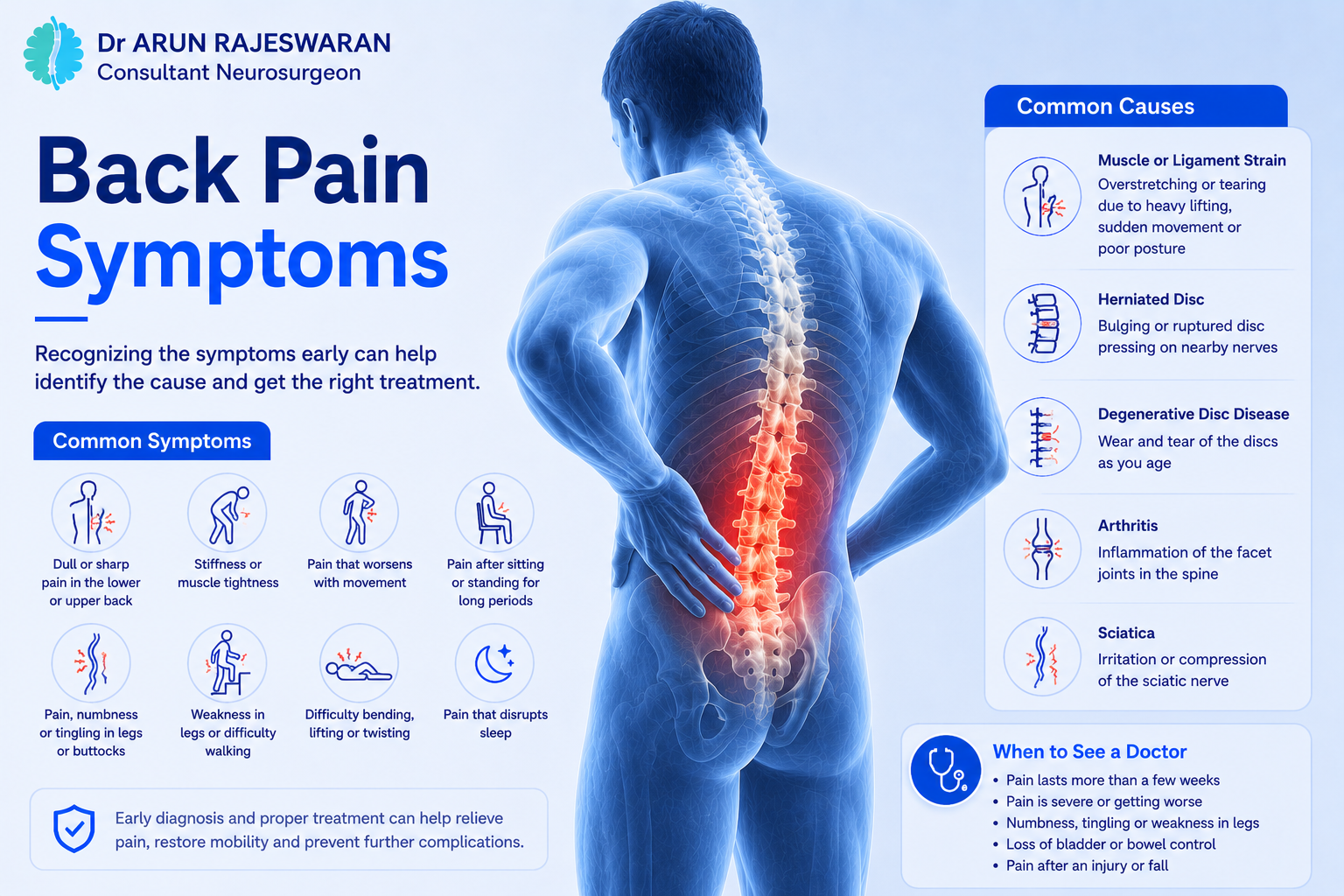
Most back pain is mechanical; it results from muscle strain, postural loading, or simple disc irritation and improves with time and conservative management. But some back pain patterns indicate structural problems that require investigation, and a small number indicate emergencies. Knowing the difference is the single most clinically important distinction in spine care.
This page explains the red flag symptoms that change back pain from a mechanical problem to a specialist problem and identifies the signs that require emergency assessment without delay.
Mechanical vs Serious Back Pain: The Key Differences
Feature | Mechanical Back Pain | Serious / Red Flag Back Pain |
|---|---|---|
Onset | After lifting, activity, or awkward posture | Gradual, no clear trigger; or sudden with trauma |
Pain pattern | Varies with position; better lying down or resting | Constant; not relieved by lying down or rest |
Time of day | Often worse evening after activity | Worse at night; disturbs sleep |
Age pattern | Any age; common 30–50s | New serious pain under 20 or over 50 more concerning |
Neurological symptoms | Absent | Present leg weakness, numbness, bladder/bowel change |
Systemic features | None | Weight loss, fever, fatigue, history of malignancy |
Response to rest | Improves | Does not improve or worsens with rest |
Expected course | Improves over 4–6 weeks | Progressive; does not follow expected recovery pattern |
Red Flag Symptoms in Back Pain
Red flags are features that require prompt investigation rather than a routine wait-and-see approach.
- Bladder or bowel dysfunction alongside back and leg pain possible cauda equina syndrome. This is a surgical emergency.
- Saddle numbness in the groin, inner thighs, and perineum. A cauda equina sign requiring emergency assessment.
- Bilateral leg weakness or numbness both legs affected simultaneously suggests central compression.
- Constant, severe back pain that is not related to posture or movement and does not improve with rest.
- Back pain that is significantly worse at night and disturbs sleep suggests inflammatory or malignant causes.
- Back pain with fever possible discitis or spinal epidural abscess requiring urgent investigation.
- Back pain in a patient with a known cancer history spinal metastasis must be excluded.
- Significant unintentional weight loss accompanying back pain.
- History of significant trauma from height, road traffic accident, sports impact with new back pain.
- New back pain in a patient over 50 without a prior history of mechanical back pain.
Cauda Equina Syndrome: The Back Pain Emergency
Cauda equina syndrome occurs when the nerve roots at the base of the spinal cord are compressed typically from a massive central disc herniation at the lumbar level. It is a surgical emergency.
The classic presentation includes:
- Severe low back pain
- Bilateral leg pain, weakness, or numbness
- Saddle area numbness the perineum, inner thighs, and groin
- Difficulty passing urine, urinary retention, or loss of bladder control
- Loss of bowel control or difficulty with defecation
Not all features need to be present for cauda equina syndrome to be the cause. Any combination of back pain with bladder or bowel dysfunction and saddle numbness is a surgical emergency. Every hour of delay in decompression reduces the chance of full neurological recovery.
If these symptoms are present, go to an emergency department immediately. Do not wait for a scheduled appointment.
Back Pain Worse at Night: What It Means
Mechanical back pain typically follows a pattern that worsens with activity and improves with rest. When back pain is worse at night, interrupts sleep, or is present continuously without positional relief, this breaks the mechanical pattern and requires investigation.
Causes of night-predominant back pain include inflammatory spondyloarthropathy (such as ankylosing spondylitis), spinal infection (discitis or osteomyelitis), and spinal tumour either primary or metastatic. These are distinct conditions requiring different management.
Back Pain with Leg Pain: Radiculopathy
Pain radiating from the back down into one or both legs is called radiculopathy or when the sciatic nerve is involved sciatica. It reflects compression of a nerve root by a herniated disc, bone spur, or narrowed spinal canal.
The character of the leg pain helps identify the nerve root involved:
- Outer thigh, outer shin, top of foot: L4/L5 nerve root L4/L5 disc herniation
- Back of thigh, calf, heel: L5/S1 nerve root L5/S1 disc herniation
- Pain radiating into both legs simultaneously: may reflect central canal stenosis requires MRI
Leg pain from nerve root compression is typically burning or electric in quality, follows a specific path, and is worsened by sitting. Significant weakness in the leg alongside the pain warrants urgent assessment.
When Does Back Pain Need an MRI?
Indication | MRI Required? | Urgency |
|---|---|---|
Back pain + bladder or bowel symptoms | Yes emergency | Same day |
Back pain + bilateral leg weakness or numbness | Yes | Same day or next day |
Red flag features present (fever, cancer history, night pain) | Yes | Within days |
Back pain + leg pain not improving after 6 weeks | Yes | Routine |
Progressive neurological deficit increasing weakness | Yes | Urgent |
Back pain after significant trauma | Yes CT first, then MRI | Same day |
Uncomplicated mechanical back pain, no red flags, first episode | Not initially required | Review if not improving at 6 weeks |
When to See a Spine Neurosurgeon
Most back pain is managed by a GP and physiotherapist without specialist involvement. A spine neurosurgeon is appropriate when:
- A neurological deficit leg weakness, foot drop, progressive numbness has developed
- Cauda equina symptoms are present immediate referral
- MRI has identified a herniated disc, spinal stenosis, or cord compression requiring surgical evaluation
- Conservative management has failed after six to twelve weeks and symptoms are significantly affecting quality of life
- Spinal metastasis, infection, or tumour is identified
- A second opinion is sought on an existing surgical recommendation
Conclusion
The majority of back pain is mechanical and self-limiting. Red flags featuring neurological deficit, bladder or bowel change, night pain, fever, or a cancer history change the assessment entirely. Cauda equina syndrome is the most urgent spinal emergency. Recognising these patterns early determines whether back pain is managed conservatively or requires urgent specialist intervention.
If you are experiencing persistent neurological symptoms, consult Dr. Arun for a detailed evaluation and personalised treatment plan.
Frequently Asked Questions
Most back pain improves within four to six weeks. See a doctor promptly if red flag features are present: neurological symptoms such as leg weakness or numbness, bladder or bowel changes, night pain that disturbs sleep, fever, significant weight loss, or a trauma history. If there are no red flags but pain has not improved meaningfully after six weeks of appropriate self-management, a GP review is appropriate.
Yes, in a minority of cases. Serious causes include cauda equina syndrome from central disc herniation, spinal infection (discitis), spinal metastasis from cancer, vertebral fracture, and inflammatory spinal arthritis. These are identified by specific patterns particularly neurological symptoms, night pain, fever, cancer history, and lack of improvement with rest.
Pain radiating from the back into the leg sciatica or radiculopathy reflects compression of a spinal nerve root, usually from a herniated disc or bone spur. The nerve carries pain signals along its entire length, so the brain perceives pain in the leg even though the source is in the spine. The distribution of leg pain identifies which nerve root is affected.
Yes. Mechanical back pain typically improves with rest. Back pain that is worse at night, wakes the patient from sleep, or is present continuously without positional relief breaks the mechanical pattern. Night-predominant back pain raises concern for inflammatory conditions such as ankylosing spondylitis, spinal infection, or tumour. Imaging and blood tests are indicated.
Cauda equina syndrome is compression of the nerve roots at the base of the spinal cord, usually from a large central disc herniation. It produces back and leg pain, saddle numbness (perineum and inner thighs), difficulty passing urine or loss of bladder control, and bowel dysfunction. It is a surgical emergency. Delay in surgical decompression increases the risk of permanent bladder, bowel, and lower limb dysfunction.
Yes. Compression of the cauda equina nerve roots causes difficulty passing urine or loss of bladder control. Compression of the spinal cord in the cervical region can also cause bladder urgency or frequency. Any combination of spinal symptoms and bladder change warrants urgent assessment.