
- 03 Aug, 2026
- Dr. Arun Rajeswaran
- No comment
The Evolution of Neurosurgery: The True Benefits of Minimally Invasive Procedures
 Neurosurgery has traditionally involved large incisions, significant disruption of muscles and surrounding tissues, and extended hospital stays. For many patients facing brain or spine surgery, concerns about pain, recovery time, and potential complications are often just as overwhelming as the condition itself. Fortunately, advances in surgical technology have transformed the way many neurological conditions are treated.
One of the most significant innovations is minimally invasive spine surgery, which uses small incisions, specialized surgical instruments, high-definition imaging, and advanced navigation systems to perform complex procedures with greater precision. These techniques minimize damage to healthy tissues while helping surgeons effectively treat a wide range of brain and spine disorders.
Whether you’re exploring treatment options or want to understand how minimally invasive spine surgery can improve surgical outcomes, learning about this advanced approach can help you make more informed decisions. From reduced pain and faster recovery to shorter hospital stays and lower surgical risks, minimally invasive techniques are changing the future of modern neurosurgery.
What is Minimally Invasive Neurosurgery?
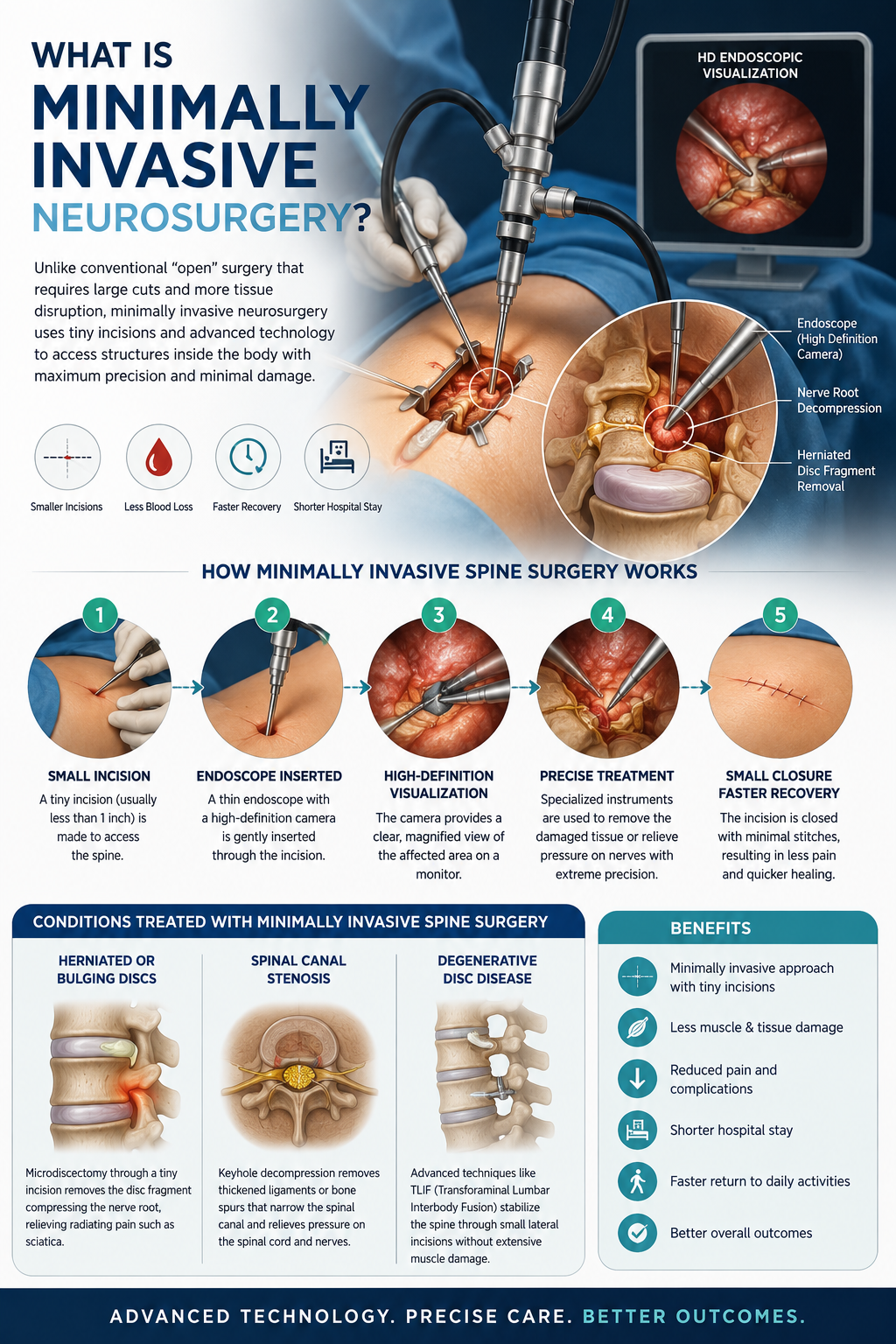
Unlike conventional “open” surgical procedures which require significant cuts in order to reach large areas of human anatomy, small incision technique uses tiny openings to gain access into human body. The neurosurgeons make use of special instruments as surgical endoscopes which are thin pipes equipped with powerful cameras and light sources that allow for watching the internal structures with great visual clarity.
This technical process gives surgeons extra precision in their work – rather than cutting through important internal structures, specific equipment permits them either to bypass the structures or to separate the soft tissues with great care.
Core Advantages of Minimally Invasive Neurosurgery
The clinical move toward keyhole techniques is driven by a clear series of functional advantages that directly impact patient outcomes and long-term well-being.
1. Minimized Tissue and Muscle Disruption
The usual open spine surgery requires the surgeon to remove the large muscles that support the spine from the bone through muscle retraction. This can result in localized ischemia or inadequate blood flow and lead to prolonged pain in the muscles after the surgery. Minimally invasive spine surgery takes advantage of tubular retractors to create a narrow space by separating the muscles along the fibers’ natural layers, and, once the instruments are removed, the muscle tissue resets itself to its normal position with very little trauma.
2. Enhanced Surgical Precision
Modern neuroendoscopy and real-time intraoperative navigation act like GPS systems for the human body. Surgeons can view highly magnified, high-definition internal landscapes on digital monitors.
This high level of clarity ensures that specialized maneuvers are executed with micrometer precision, protecting the intricate boundary lines between healthy brain or spinal tissue and underlying pathology.
3. Reduced Surgical Risk
Every surgical intervention carries a calculated baseline of risk. By shortening the physical footprint of the procedure, keyhole strategies systematically lower these hurdles:
- Lower Infection Rates: Smaller surface exposures give airborne pathogens fewer opportunities to colonize the surgical site.
- Decreased Intraoperative Blood Loss: Working through narrow corridors and using precise micro-instruments significantly minimizes vascular disruption.
- Fewer Anesthetic Complications: Because these procedures are often faster and less physically traumatic, the overall strain on the cardiovascular and respiratory systems is reduced.
Minimally Invasive Spine Surgery: A Focused Look
When evaluating structural issues along the axial skeleton, keyhole engineering has changed how specialists address degenerative conditions and nerve pathway restrictions. The approach is highly effective for treating:
- Herniated or Bulging Discs: Through a microdiscectomy, a tiny incision allows the surgeon to isolate the specific disc fragment compressing a nerve root, instantly relieving radiating leg or arm pain (sciatica).
- Spinal Canal Stenosis: Keyhole decompression techniques allow the removal of thickened ligaments or bone spurs that constrict the central canal, freeing up space for the spinal cord and exiting neural structures.
- Degenerative Disc Disease: Specialized spinal fusions, such as a Transforaminal Lumbar Interbody Fusion (TLIF), can now be performed through small lateral incisions, stabilizing the spine without extensive muscle peeling.
Minimally Invasive Brain Surgery Benefits
Keyhole techniques have significant benefits even for patients suffering from ailments in their skulls. Minimally invasive brain surgery protects the very intricate structure of the cerebral cortex, which allows for excellent outcomes for patients.
[Image showing microscopic or endoscopic view of the neural pathways]
One example is endoscopic pituitary surgery (transsphenoidal endoscopy). Traditional methods of tumor removal in the base of the brain demanded the use of a big craniotomy during which a significant section of the skull was removed and the brain tissue manipulated.
With neuroendoscopy, the surgeon reaches the pituitary gland through the nasal passages of the patient.
The Recovery Journey: What to Expect
In today’s medical practice, the most important thing to judge a medical intervention is how swiftly and without complications a person can go back to his or her normal life schedule. The period of recovery after any kind of minimally invasive operation can be constantly assessed as shorter and more convenient than that with traditional open operations.
Moreover, as the localized inflammation is less, patients experience less pain after surgery in comparison with open surgery techniques. Therefore, the patients require fewer strong doses of opiate medications which can bring about side effects such as drowsiness, vomiting, and constipation.
Besides, the time spent in the hospitals is relatively short. A lot of minor keyhole surgeries can be done on outpatient condition. Many slightly complicated surgeries require patients to stay in the hospital from one to three days as opposed to several days and even weeks that are needed for conventional surgeries.
When there is no damage to the surrounding muscles, physical rehabilitation can begin much earlier which facilitates the process of returning to full mobility.