
- 01 Aug, 2026
- Dr. Arun Rajeswaran
- No comment
Demystifying Neuroimaging: When Do You Actually Need a Brain Scan?
Wondering when a brain scan is necessary? Learn the top neurological symptoms that need a CT scan or a brain MRI, from headaches to stroke signs.
Persistent headaches, sudden dizziness, or other unusual neurological symptoms can be alarming and often raise an important question: when do you need a brain scan?. In many cases, these symptoms may prompt your primary care physician or a specialist to recommend a brain imaging test, such as an MRI or CT scan. Understanding which warning signs require further evaluation can help you seek timely medical care. Knowing when do you need a brain scan is essential for identifying serious neurological conditions early and ensuring the right diagnosis and treatment.
In many cases, these symptoms may prompt your primary care physician or a specialist to recommend a brain imaging test, such as an MRI or CT scan. Understanding which warning signs require further evaluation can help you seek timely medical care. Knowing when do you need a brain scan is essential for identifying serious neurological conditions early and ensuring the right diagnosis and treatment.
In the scope of modern medicine, neuroimaging is not used as a very comfortable way of diagnosing common headaches. On the contrary, it serves as an effective diagnostic tool, which doctors can use in case they want to look at the internal structure of the skull and get insights into the central nervous system’s health.
Regardless of whether the patient is receiving a radiology test right now, preparing for one or even in need of a special neurological evaluation, the understanding of the key triggers for imaging studies will facilitate the process of getting medical assistance.
When Do You Need a Brain Scan? What Is a Brain Scan and How Does It Work?
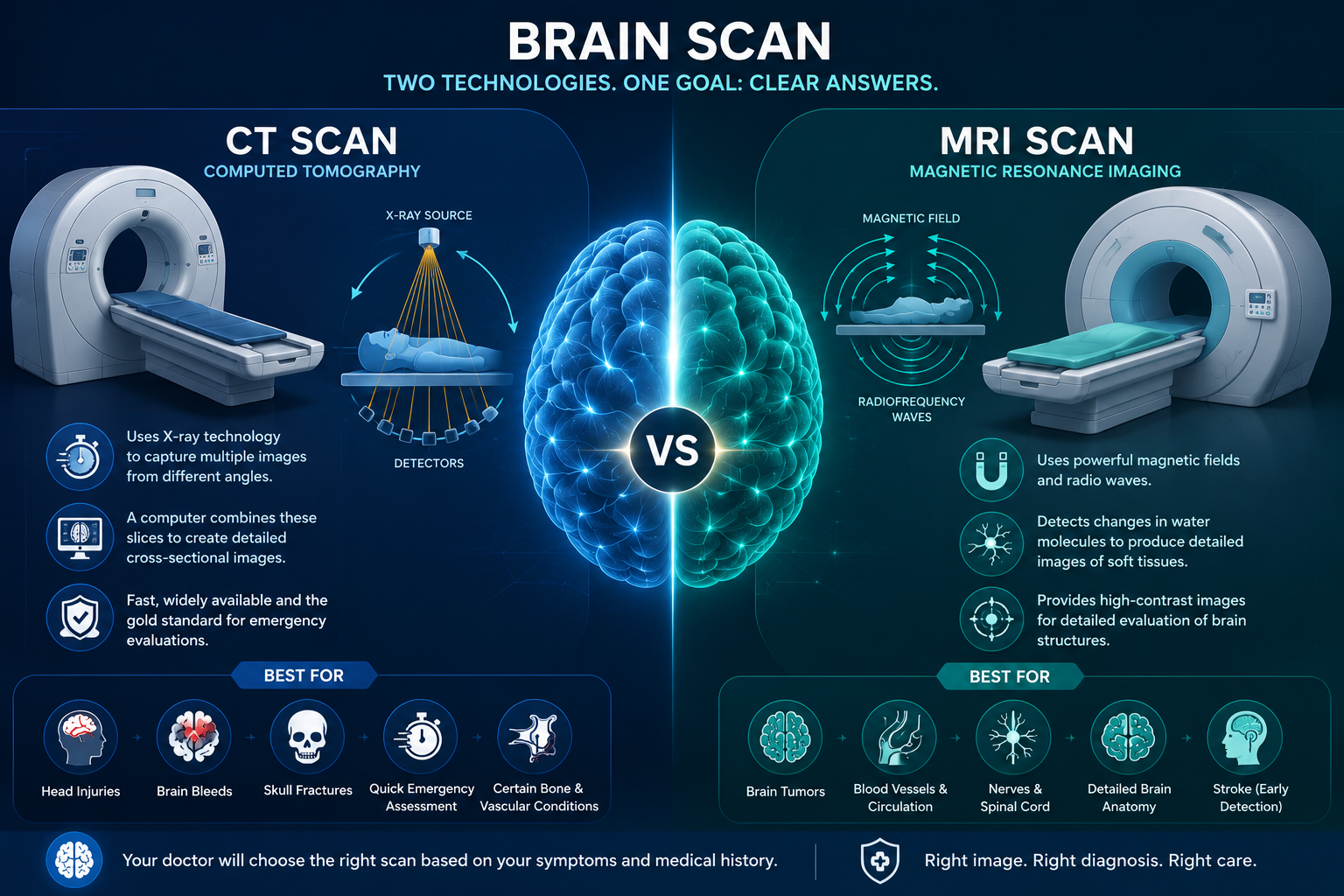
Before exploring the clinical criteria for an imaging referral, it helps to understand the two main types of diagnostic tools used in modern radiology: the Computed Tomography (CT) scan and the Magnetic Resonance Imaging (MRI) scan. While both create structural maps of the brain, they use entirely different physics and are chosen for different clinical needs.
Computed Tomography (CT Scan)
CT scan is a fast imaging technique. It uses advanced X-ray techniques. You lie on a table inside a large circular scanner while X-ray sources move very fast around you to get many images. A computer then records these images.
Because of its speed and availability, CT scan is the most preferred test in emergencies.
Magnetic Resonance Imaging (MRI Scan)
MRI uses no X-rays at all. It uses strong magnetic fields and radio waves to interact with water molecules in your body.
MRI provides highly detailed images with excellent contrast of soft tissues, making it the best method for examining details of brain anatomy, cranial nerves, and the slightest changes in blood vessels.
Critical Neurological Symptoms That Need a CT Scan
Because a CT scan can be completed in under five minutes, it is primarily used when time is a critical factor or when doctors need to evaluate dense structural changes like bone or acute bleeding. The key symptoms that need a ct scan include:
- Acute, Sudden-Onset Headaches: A severe, blinding headache that peaks within seconds—often described by patients as a “thunderclap” or the worst headache of their life. This pattern can indicate an acute intracranial hemorrhage (bleeding in the brain).
- Traumatic Brain Injuries (TBI): Any significant physical trauma to the head resulting from a motor vehicle collision, a serious fall, or an impact injury. A CT scan instantly checks for skull fractures and localized contusions (bruises on the brain).
- Sudden Stroke Symptoms: The rapid onset of facial drooping, arm weakness, or slurred speech. Emergency teams use an immediate CT scan to rule out a hemorrhagic stroke (bleeding) before administering clot-busting medications for an ischemic stroke.
- Acute Alterations in Mental Status: Sudden, unexplained confusion, delirium, or a rapid drop in consciousness that cannot be traced to metabolic or drug-related factors.
Clear Signs You Need a Brain MRI
If your condition is chronic, progressive, or requires looking closely at deep soft tissues, a specialist will recommend an MRI. Because it offers superior soft tissue definition, an MRI is ordered when a patient shows specific, ongoing changes. The primary signs you need a brain mri include:
- Chronic, Progressive Headaches: Headaches that have steadily worsened over weeks or months, or a long-standing headache pattern that suddenly changes in character or intensity.
- New-Onset Seizures in Adulthood: Experiencing a seizure for the very first time as an adult is a strong clinical indicator that requires a high-resolution MRI to check for underlying structural masses.
- Persistent Dizziness or Balance Deficits: Chronic unsteadiness while walking, recurring vertigo, or a loss of physical coordination that suggests an issue within the cerebellum (the brain’s coordination center).
- Unexplained Cranial Nerve Anomalies: Progressive changes in vision (such as double vision or loss of peripheral sight), unexplained hearing loss, tinnitus, or facial numbness.
- Gradual Cognitive or Personality Shifts: Noticeable, uncharacteristic changes in behavior, progressive memory loss, or a decline in cognitive processing speed that goes beyond typical aging.
Do I Need a Scan for Headaches?
One of the most frequent questions patients ask their doctors is: Do I need a scan for headaches? The reassuring answer for most people is no. The vast majority of headaches are primary headache disorders, such as standard migraines, tension headaches, or cluster headaches. These conditions are diagnosed through a careful medical history and do not show up on structural scans.
However, a brain scan becomes medically necessary when a headache is accompanied by specific “red flag” clinical features. Medical professionals use the acronym SNOOP to spot these warnings:
- S – Systemic symptoms: Headaches accompanied by unexplained fever, night sweats, or unexpected weight loss.
- N – Neurological signs: Headaches occurring alongside localized weakness, numbness, changes in vision, or personality shifts.
- O – Onset: A sudden “thunderclap” headache that goes from zero to maximum intensity within less than a minute.
- O – Older age: A brand-new headache pattern starting in individuals over the age of 50.
- P – Progression: A headache that grows steadily worse over time or changes completely when you shift your physical position (such as standing up versus lying down).
If your headache checks any of these boxes, a comprehensive evaluation and diagnostic imaging are vital to rule out secondary causes, such as increased fluid pressure or structural lesions.
What to Expect: Scan Preparation and Care
The diagnostic imaging process may be uncomplicated, but knowing what preparations to undertake can help ease your worries.
CT scan preparation is simple. If your doctor requests you to have contrast imaging done, you may need to fast for a few hours before the procedure, and a small intravenous line may be inserted into your arm.
MRI scan preparation requires paying close attention to safety. Since a powerful magnet is used in the imaging machine, you must remove any metallic objects, such as jewelry, watches, bobby pins, and any clothes with metal zippers.
Those having metallic implants inside their bodies like older pacemakers, cochlear implants or specific vascular clips must inform the team in advance, though many modern implants do not pose MRI risks. If you suffer from claustrophobia, make sure to inform your doctor earlier so they may provide you with mild relaxation solutions for the time of the longer MRI scan.
Partnering with an Expert for Your Neurological Health
Dealing with complicated neurological symptoms can be very daunting, but to have an accurate diagnosis at the right time is the first step toward recovery for the patient. Knowing when a brain scan is needed involves clinical expertise in assessing the particular physical symptoms of the patient and their correct imaging technique.
If you experience chronic headaches or sensory alterations, or if you want the second opinion of a specialist about a newly obtained imaging study report, the best option for you is to seek specialized help. Visit Dr. Arun Rajeswaran’s official webpage to meet a team of medical professionals who can provide you with the necessary assistance and help ensure your health.