
Blog
Slipped Disc Symptoms: What You Feel, Why It Happens, and When to See a Spine Specialist
- 29 May, 2026
- Dr. Arun Rajeswaran
- No comment
Slipped Disc Symptoms: What You Feel, Why It Happens, and When to See a Spine Specialist
A lot of patients come in thinking they have a muscle problem. They have been managing back pain for weeks, maybe longer, and somewhere along the way the pain started travelling down one leg. That is when things usually change.
Leg pain from a back problem catches people off guard. It does not feel like what they expect a spine issue to feel like.
A slipped disc is one of the most common causes. And understanding what it produces what the symptoms, what they actually feel like, where they go, and why helps patients recognise the pattern sooner and get the right help.
What a Slipped Disc Actually Is
The discs in your spine sit between the vertebrae. Each one acts as a cushion and a shock absorber. They have a tough outer shell and a softer, gel-like centre.
A slipped disc, the correct term is herniated disc, happens when the soft inner material pushes through a weakness or tear in that outer shell. Sometimes it bulges outward. Sometimes it breaks through entirely.
On its own, a herniated disc is not always painful. What causes pain is what the disc presses against. When the herniated material pushes into the space where a nerve root exits the spinal column, that nerve gets compressed. That is when symptoms start.
The First Signs Most People Notice
Most people do not feel a dramatic pop or sudden event. The disc often herniates gradually, and symptoms creep in.
Early signs can include a dull ache in the lower back, stiffness after sitting, or a pulling sensation when bending or twisting. Many people assume it is a muscle strain. They reach for painkillers, rest for a few days, and expect it to pass.
Sometimes it does. Often it does not.
The moment nerve compression develops, the picture changes. Pain starts radiating. And that is usually when people realise something more is going on.
Slipped Disc Symptoms in the Lower Back
The lumbar spine the lower back is where most disc herniations occur. The L4/L5 and L5/S1 levels are the most commonly affected.
Lower back pain is usually present, but it is not always the most prominent symptom. Some patients describe surprisingly mild back pain alongside leg symptoms that feel far worse.
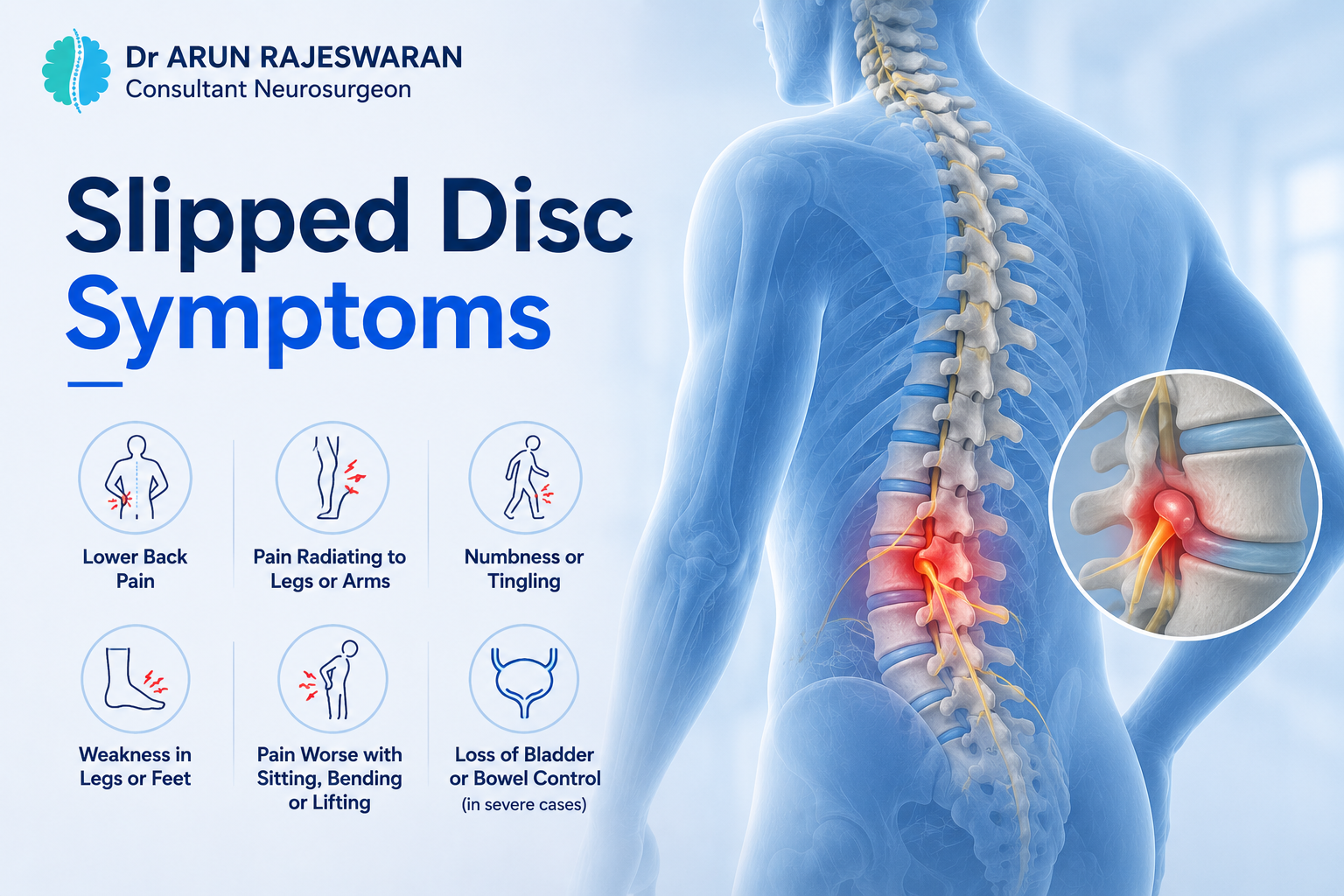
The leg pain called radiculopathy, or more commonly sciatica when it involves the sciatic nerve follows a specific route depending on which nerve is compressed. An L4/L5 herniation tends to produce pain running down the outer thigh, the outer shin, and into the foot. An L5/S1 herniation typically travels down the back of the thigh and calf, into the heel and sole.
Patients describe the pain in different ways. Burning. Electric. Sharp when moving. A deep aching that does not fully go away. Some say walking short distances becomes difficult. Others manage movement reasonably well but cannot sit for long.
Numbness and tingling often accompany the pain. They follow the same nerve pathway. A patch of skin along the leg or foot feels different to touch, or feels like it has gone partially asleep.
Weakness is the symptom that demands the most attention. Difficulty lifting the foot when walking what clinicians call foot drop is an L4/L5 compression sign. Weakness pushing off the toes is associated with L5/S1. Muscle weakness means the nerve is under significant pressure, and that changes the urgency of the situation.
Cervical Slipped Disc Symptoms
Disc herniations in the neck and the cervical spine produce a different set of symptoms. The pain centres in the neck and often travels into one arm.
Arm pain from a cervical disc herniation can feel similar to the leg pain from a lumbar herniation. Sharp, burning, electric, or aching pain running from the neck into the shoulder, down the upper arm, into the forearm, and sometimes into specific fingers. The exact distribution depends on which level is affected.
At C5/C6, pain and numbness commonly affect the outer arm and thumb side of the hand. At C6/C7, the middle fingers are often involved.
Neck stiffness is common. Headaches at the base of the skull can occur. Some patients notice that certain head positions, looking upward or turning sharply, make the arm pain worse.
A specific and more serious complication of cervical disc herniation is spinal cord compression called myelopathy. When the disc not only compresses a nerve root but pushes against the cord itself, symptoms are different and more widespread. Difficulty with fine hand movements, clumsiness, unsteadiness when walking, and sometimes bladder changes can all indicate cord involvement. This presentation needs urgent specialist assessment.
Slipped Disc vs Muscle Strain: How to Tell the Difference
This is a common question, and understandably so. Both cause back pain. Both can be triggered by movement.
The key difference is nerve involvement. Muscle strains hurt in the back. They are tender to local pressure. They get better with rest over a week or two.
A slipped disc pressing on a nerve produces symptoms that travel. Pain, numbness, or tingling extending into the leg or arm is not from a muscle. Muscles do not produce radiating symptoms along a nerve distribution.
Weakness in a limb is another clear distinction. Muscle strains cause local muscle soreness. They do not cause the foot to feel heavy or the hand grip to weaken on one side.
If symptoms are confined to the back, move around with posture, and improve steadily over a short period, it is more likely a soft tissue or muscle problem. When symptoms travel into a limb, when they are electric or burning in quality, or when neurological signs appear, the picture changes.
Symptoms That Should Not Be Waited Out
Most slipped discs can be managed conservatively. But some symptoms need prompt attention.
Progressive weakness is one. If the arm or leg is getting weaker over days, that nerve is under increasing pressure. This should be assessed urgently.
Foot drop the inability to lift the foot at the ankle is a significant neurological sign. It suggests severe L4/L5 compression. It needs prompt imaging and specialist review.
Bilateral symptoms of pain, numbness, or weakness on both sides simultaneously raise concern about central canal compression rather than a single nerve root. This is more serious.
Bladder or bowel dysfunction alongside back and leg symptoms is a surgical emergency. The inability to pass urine, loss of bladder or bowel control, or numbness in the saddle area between the legs is the presentation of cauda equina syndrome. This requires emergency evaluation and often emergency surgery. Do not wait.
Can a Slipped Disc Heal Without Surgery?
Yes, in most cases.
The majority of disc herniations respond to conservative management over weeks to months. The herniated material can reduce in size as the body reabsorbs it. Inflammation around the nerve settles. Symptoms improve.
Physiotherapy, targeted exercises, activity modification, pain management, and sometimes nerve-specific medications like gabapentin or pregabalin are the mainstay of non-surgical treatment.
Surgery is considered when conservative treatment has not produced adequate improvement over a reasonable period, when symptoms are severe and function is significantly impaired, or when neurological signs are present or worsening.
The goal of surgery is to decompress the nerve. For lumbar disc herniations, a microdiscectomy a minimally invasive procedure removing the herniated fragment reliably achieves this with good recovery rates.
When to See a Spine Specialist
If leg or arm pain has been present for more than a few weeks alongside back or neck pain, getting an assessment is the right step. An MRI confirms where the herniation is, which nerve is involved, and how significant the compression looks.
Most patients who come to see me with these symptoms leave with a clear diagnosis and a conservative plan to try first. Surgery is rarely the first conversation. But having the imaging and a specialist opinion means that if things are not improving, the next step is already clear.
If weakness has developed, symptoms are worsening, or bladder and bowel function is affected, come sooner rather than later.
Frequently Asked Questions
Early signs are often lower back pain or neck pain that feels different to usual, stiffness when moving, and a pulling sensation when bending. For many patients, the more obvious sign is when pain starts radiating into a leg or arm, along the course of a compressed nerve root. Numbness or tingling in the limb often accompanies the pain. These travelling symptoms are usually what alerts patients that something beyond a simple muscle problem is happening.
Yes, most do. The majority of disc herniations improve with conservative treatment over a period of weeks to a few months. The herniated material can shrink as the body reabsorbs it, and inflammation around the nerve settles. Physiotherapy, activity modification, and targeted pain management are the first line of treatment. Surgery is considered if symptoms are not improving adequately, if neurological signs such as weakness are present, or if the situation is affecting daily life significantly. Most patients do not end up needing an operation.
The disc itself does not cause leg pain directly. When herniated disc material compresses a nearby nerve root as it exits the spinal column, that nerve carries pain signals all the way along its route into the leg. The brain interprets the pain as coming from the leg, even though the source of compression is in the spine. This is called referred pain or radiculopathy. The exact location of the leg pain in which part of the thigh, calf, or foot depends on which nerve root is being compressed.
A muscle strain hurts in the back or neck, is tender when pressed locally, and typically improves with rest over a week or two. A slipped disc pressing on a nerve produces pain that travels into a limb along a nerve distribution. The quality is often electric, burning, or sharply shooting rather than the dull ache of a muscle strain. Numbness, tingling, and weakness in the arm or leg do not come from muscle strains. If symptoms are travelling into a limb or if there is any neurological change, imaging is needed to assess the spine.
If leg or arm pain has not improved after a few weeks of conservative management, or if neurological symptoms such as numbness, tingling, or weakness have appeared, a spine specialist assessment is appropriate. An MRI will show the herniation clearly and guide treatment decisions. If weakness is progressive, if foot drop has developed, or if bladder or bowel symptoms have appeared alongside the usual symptoms, this needs urgent assessment, not a routine wait-and-see approach.