
Blog
Cervical Disc Problems: What They Feel Like, What They Mean, and How They Are Treated
- 30 May, 2026
- Dr. Arun Rajeswaran
- No comment
Cervical Disc Problems: What They Feel Like, What They Mean, and How They Are Treated
Most people associate disc problems with the lower back. The neck gets less attention.
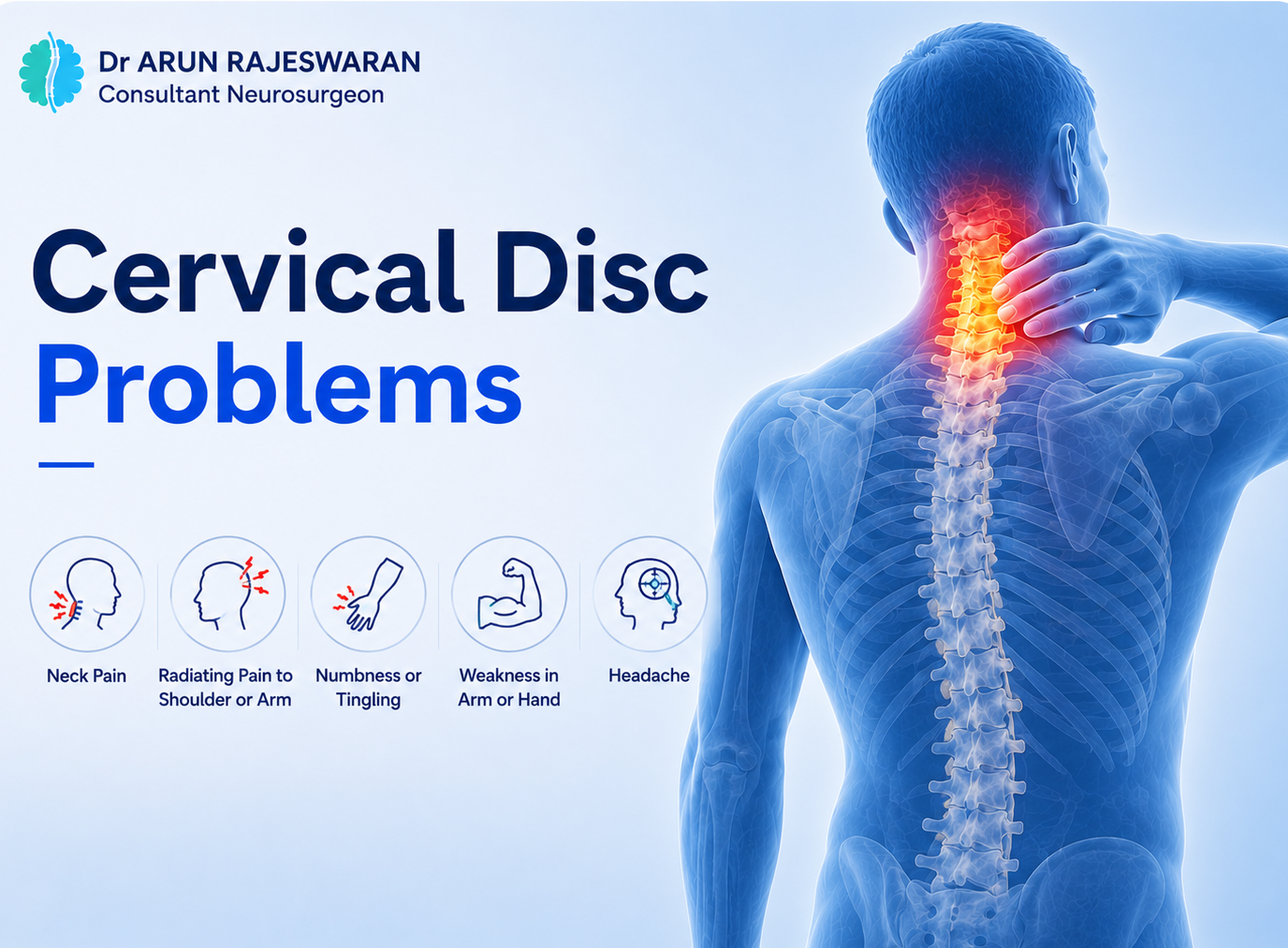
But cervical disc problems and disc issues in the neck are surprisingly common, and they can produce symptoms that are both confusing and disabling. Arm pain that seems unrelated to the neck. Fingers that tingle at night. A grip that has weakened on one side. Some patients describe shoulder pain that has been treated for months before anyone scans the cervical spine.
Understanding what is happening in the neck, and what it can cause, makes these symptoms far easier to interpret.
The Cervical Disc: What It Does and Why It Fails
Seven vertebrae make up the cervical spine. Between each one sits a disc, a tough outer ring with a softer centre acting as a cushion and allowing the neck to move in multiple directions.
Each disc also sits adjacent to nerve roots exiting the spinal canal. These roots carry motor and sensory signals to specific parts of the arm and hand. When a disc herniates, bulges, or degenerates to the point where it compresses a nearby nerve root, symptoms travel along the path that nerve serves.
Disc problems in the neck occur most commonly at C5/C6 and C6/C7. These levels experience the most movement and the most mechanical load over time.
Types of Cervical Disc Problems
Cervical disc herniation is when the inner disc material protrudes through the outer casing, pressing against a nerve root or, in some cases, the spinal cord itself. This can happen acutely from a sudden strain or movement, or it can develop gradually on top of pre-existing degeneration.
Cervical disc degeneration is the gradual age-related loss of disc height, hydration, and elasticity. As discs degenerate, the space between vertebrae narrows, and bone spurs called osteophytes can form at the disc margins. These bony growths can encroach on nerve root spaces even without a frank disc herniation.
Cervical spondylosis is the umbrella term for these degenerative changes in the cervical spine. It is extremely common over the age of 40 and does not always cause symptoms. When it does, neck pain, stiffness, and eventually nerve compression symptoms develop.
Cervical Radiculopathy: The Nerve Root Compression
Cervical radiculopathy is the clinical syndrome that results from nerve root compression in the cervical spine. The term is used more by clinicians, but the experience it describes is familiar to many patients.
Pain starts in the neck and travels down the arm, following the distribution of the compressed nerve root. At C5/C6, this typically means pain running into the outer upper arm, forearm, and toward the thumb and index finger. At C6/C7, the middle finger and ring finger tend to be involved.
The pain quality is often described as sharp, burning, or electric. Some patients compare it to an injection sensation running down the arm. Certain neck positions make it worse. Turning the head or looking up often increases the arm pain.
Alongside pain, numbness and tingling follow the same distribution. Pins and needles in specific fingers are a reliable indicator of which nerve root is involved.
Weakness is less common but more significant when it appears. Difficulty with grip strength, trouble raising the arm, or weakness lifting objects overhead are signs of motor nerve involvement. These warrant prompt assessment.
Cervical Myelopathy: When the Cord Is Compressed
This is the more serious presentation, and it deserves a clear explanation.
The spinal cord runs through the cervical canal. If a disc herniation is large enough, or if degenerative changes have significantly narrowed the canal, the cord itself, not just a nerve root, can be compressed. This is cervical myelopathy.
Myelopathy symptoms are different from radiculopathy. Rather than pain and numbness in one arm, cord compression produces changes that affect the hands, the legs, and sometimes balance and bladder.
Patients often describe difficulty with fine hand movements buttoning clothes, handling small objects, and writing. Handwriting may deteriorate. The legs can feel heavy or stiff. Walking becomes unsteady. Some patients trip more often or feel less confident on stairs.
These symptoms can develop so gradually that patients adapt to them, assuming it is just part of getting older. It is not.
Cervical myelopathy is a progressive condition. Without treatment, most cases get worse over time. Early surgical decompression offers the best chance of preventing further deterioration and, in some patients, achieving recovery of function.
If any of these cord-related symptoms are present, specialist assessment should not be delayed.
Diagnosing Cervical Disc Problems
The consultation starts with a careful history and neurological examination. Which fingers are numb? Where exactly does the arm pain go? Is there any hand clumsiness or change in walking?
MRI of the cervical spine is the primary investigation. It shows disc herniation, canal narrowing, cord compression, and nerve root involvement clearly. It gives a detailed picture of what is happening at each level.
CT myelogram injecting contrast into the spinal fluid before CT scanning is occasionally used when MRI is contraindicated or when surgical planning requires more bony detail.
Nerve conduction studies and electromyography (EMG) can help map which nerve roots are functionally affected, particularly in complex cases where the imaging does not fully explain the symptoms.
Conservative Treatment
Not every cervical disc problem needs surgery. Many patients improve with conservative management.
A soft cervical collar worn short-term during an acute flare reduces neck movement and can give the inflammation around the nerve root time to settle. It is not a long-term solution.
Physiotherapy for cervical radiculopathy focuses on manual therapy, specific neck exercises, and traction techniques that can reduce nerve root pressure. A trained cervical physiotherapist can make a significant difference.
Medications follow the same principles as lumbar disc treatment: anti-inflammatories, nerve pain agents like gabapentin or pregabalin, and short-term muscle relaxants where spasm is prominent.
Cervical epidural steroid injections, or selective nerve root block injections, deliver corticosteroid directly to the inflamed nerve root. They can provide meaningful relief and support physiotherapy engagement.
Surgery for Cervical Disc Problems
When conservative treatment has not resolved symptoms adequately, when neurological deficits are present or worsening, or when myelopathy has been diagnosed, surgery becomes appropriate.
Anterior cervical discectomy and fusion (ACDF) is the most commonly performed procedure for cervical disc herniation. Through a small incision at the front of the neck, the disc is removed and replaced with a bone graft or cage device. The adjacent vertebrae fuse together over the following months. It reliably decompresses the nerve root and cord, and most patients notice a significant reduction in arm pain in the days after surgery.
Cervical disc arthroplasty (disc replacement) is an alternative to fusion at certain levels, preserving motion at the treated segment. It is suitable for selected patients and offers the advantage of maintaining more normal neck movement long-term.
Posterior cervical foraminotomy is a keyhole procedure from the back of the neck that enlarges the exit point for the nerve root without requiring disc removal or fusion. It is appropriate in specific cases.
The choice of procedure depends on the levels involved, the type of pathology present, and the individual patient’s anatomy.
Frequently Asked Question
The most common symptoms are neck pain, arm pain along the distribution of a compressed nerve root, numbness or tingling in specific fingers, and sometimes arm weakness. The pain can feel sharp, burning, or electric and tends to follow a specific path depending on which disc level and nerve root are involved. When the spinal cord is involved rather than just a nerve root, symptoms include hand clumsiness, leg stiffness, unsteady walking, and in some cases bladder changes. These cord-related symptoms need prompt assessment.
Yes, and this is actually one of the most common presentations. When a cervical disc compresses a nerve root, pain, numbness, and tingling travel along that nerve’s entire route into the arm and hand. The specific distribution which part of the arm is affected, which fingers tingle depends on the level of the herniation. Patients often attend shoulder clinics or physiotherapy for arm or shoulder pain for some time before the cervical spine is identified as the cause. If arm pain is accompanied by tingling in the fingers and neck movement makes it worse, a cervical MRI is the right investigation.
Cervical radiculopathy is the clinical syndrome caused by compression of a nerve root in the cervical spine. It produces pain radiating into the arm along the path of the compressed nerve, accompanied by numbness, tingling, and sometimes weakness in the arm or hand. It is different from referred pain from the neck muscles, which tends to be more diffuse and less specific in its distribution. Cervical radiculopathy has a characteristic pattern that an experienced clinician can identify from the history and examination before imaging confirms the level.
Surgery is appropriate when conservative treatment has not produced adequate improvement after a reasonable period, when neurological deficits such as arm weakness are present or worsening, or when cord compression causing myelopathy has been identified. Myelopathy, in particular, is a condition where early surgical decompression gives the best results. Waiting for significant neurological deterioration before operating reduces the chance of recovery. If imaging shows cord compression and functional symptoms are present, a prompt surgical opinion is important.
Many cases of cervical radiculopathy improve with conservative management, including physiotherapy, medication, and sometimes nerve root injections, over a period of weeks to a few months. The natural history of cervical disc herniation is often favourable without surgery. Myelopathy from cord compression is different. Its natural history is generally progressive rather than self-limiting, and conservative treatment does not adequately protect the cord from ongoing damage. For myelopathy, surgery is usually recommended rather than extended conservative management.