
Blog
Weakness in Body: What Causes It, When It Is Neurological, and When to Act Quickly
- 09 Jul, 2026
- Dr. Arun Rajeswaran
- No comment
Weakness in Body: What Causes It, When It Is Neurological, and When to Act Quickly
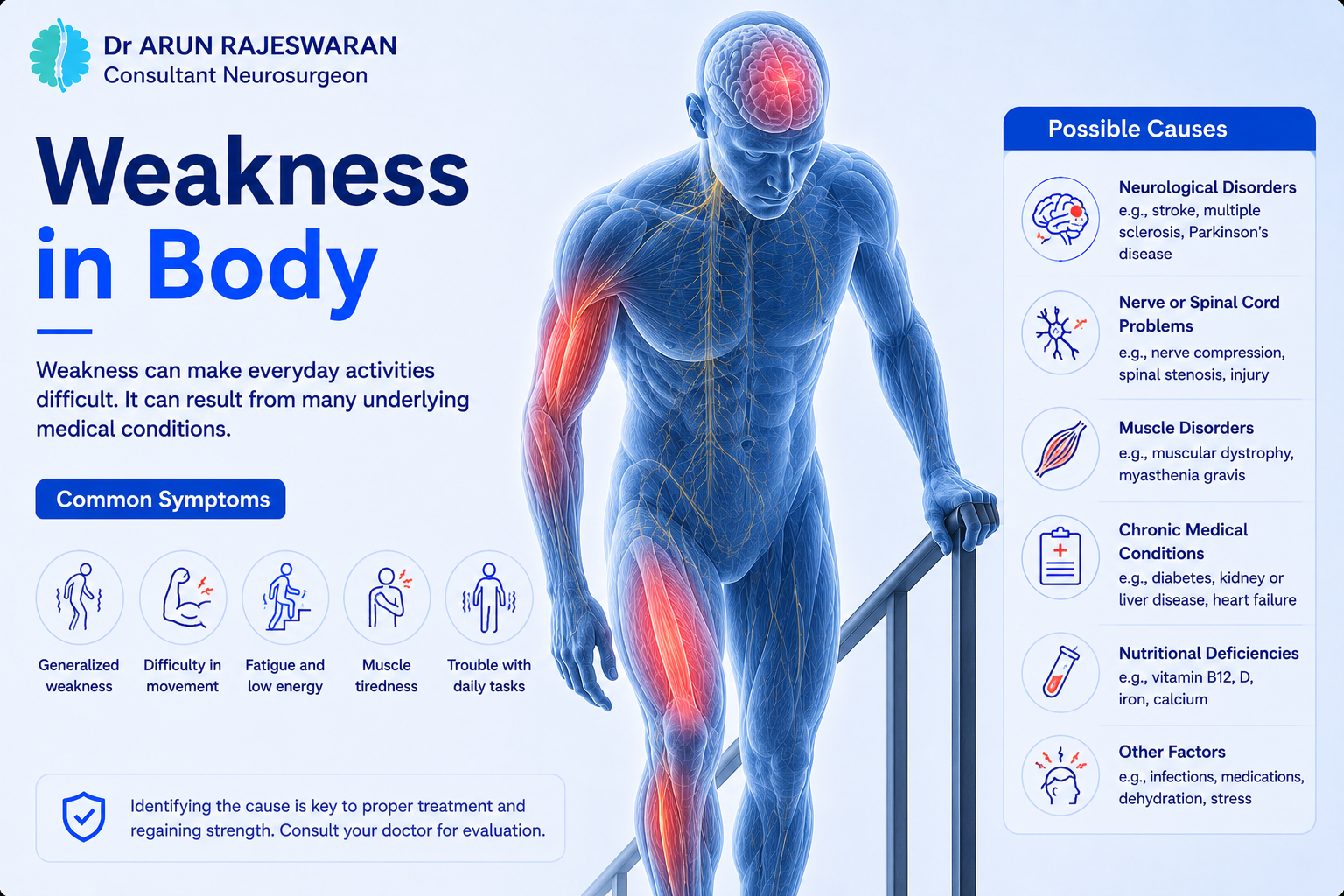
Weakness is not the same as tiredness. Fatigue, the feeling of being tired and drained is extremely common and usually not neurological. True muscle weakness where the limb cannot generate the force it should, regardless of effort is a different symptom with a different significance. Distinguishing between the two is the first clinical step.
When weakness is genuine when an arm cannot lift, a leg drags, a grip has measurably weakened it is often neurological. It may originate in the brain, the spinal cord, a nerve root, a peripheral nerve, or the muscle itself. Identifying where the problem sits determines the diagnosis and the urgency.
Weakness vs Fatigue: An Important Distinction
Feature | True Weakness | Fatigue / Tiredness |
|---|---|---|
Definition | Reduced muscle power; limb cannot generate normal force | Generalised exhaustion; effort feels harder than it should |
Pattern | Specific muscle groups or one side | Generalised; affects whole body |
Onset | Can be sudden or gradual | Usually gradual |
Rest effect | Does not fully resolve with rest | Improves with rest |
Neurological sign? | Yes focal weakness is a neurological finding | Not in itself a neurological sign |
Urgency | Requires neurological assessment | Often managed at primary care level initially |
Brain Causes of Weakness
The motor cortex in the brain controls voluntary movement on the opposite side of the body. Damage to this area from stroke, tumour, haemorrhage, or demyelinating disease produces weakness on the contralateral (opposite) side.
Stroke
Sudden weakness on one side of the body face, arm, and leg is the classic stroke presentation. It comes on over seconds to minutes. Other features include facial drooping, speech difficulty, and loss of coordination. This is a time-critical emergency. Every minute matters.
Brain Tumour
A tumour growing near the motor cortex produces progressive weakness that worsens over days to weeks. It does not come and go, it gradually worsens. It may be accompanied by headache, personality change, or seizures.
Multiple Sclerosis
MS produces episodic neurological symptoms including weakness, which may come on over hours to days and partially or fully recover. A young adult with unexplained episodes of one-sided weakness, visual disturbance, or sensory change should be assessed for MS.
Spinal Cord Causes of Weakness
Cervical Myelopathy
Narrowing of the cervical spinal canal compresses the spinal cord in the neck. This produces progressive weakness in the arms and legs, clumsiness of the hands, balance problems when walking, and sometimes bladder changes. The onset is usually gradual. Patients often attribute the symptoms to aging before the correct diagnosis is made.
Cervical myelopathy is progressive and does not reliably improve without surgical decompression. Early diagnosis matters.
Spinal Cord Compression from Disc or Tumour
An acutely herniated disc or a tumour pressing on the spinal cord can cause rapidly progressive leg weakness. Bilateral leg weakness developing over hours or days is a spinal emergency until proven otherwise.
Nerve Root and Peripheral Nerve Causes
Lumbar Disc Herniation
A herniated disc compressing the L4/L5 nerve root causes foot drop, the inability to lift the foot at the ankle when walking. The patient catches the toe on the floor. This is a significant neurological sign. Foot drop from acute disc compression warrants prompt assessment.
Peripheral Neuropathy
Damage to the peripheral nerves themselves can produce distal weakness, hands and feet affected first. Causes include diabetes, alcohol, certain medications, and immune-mediated conditions.
Guillain-Barré Syndrome
An ascending paralysis starting in the legs and progressing upward over days. Typically follows a viral infection. Can become life-threatening if it reaches the breathing muscles. Rapidly progressive limb weakness spreading from feet upward is a medical emergency.
Neuromuscular Conditions
Myasthenia Gravis
A condition where the junction between nerve and muscle does not work properly. Produces fatigable weakness muscle power is initially adequate but deteriorates with use. Drooping eyelids and double vision are common features.
Motor Neuron Disease
Progressive degeneration of motor neurons causes muscle weakness and wasting. Initially affects one limb or the speech and swallowing muscles. It is progressive and does not recover.
Emergency Weakness Presentations
- Sudden one-sided weakness of face, arm, and leg possible stroke. Emergency services immediately.
- Rapidly progressive weakness, both legs spreading upward over hours possible Guillain-Barré syndrome. Urgent hospital assessment.
- Leg weakness with bladder or bowel dysfunction causes equina syndrome or spinal cord compression. Emergency.
- Weakness following significant trauma to the neck or back spinal cord injury until proven otherwise.
Diagnosis and Tests
- Neurological examination: maps which muscle groups are affected and identifies the pattern upper motor neuron (brain/cord) vs lower motor neuron (nerve/root/muscle)
- MRI Brain: if stroke, tumour, MS, or other brain cause is suspected
- MRI Spine: if cervical myelopathy, disc herniation, or cord compression is the likely cause
- EMG and Nerve Conduction Study: distinguishes nerve disease from muscle disease; identifies which nerves or roots are affected
- Blood tests: muscle enzymes (CK) for muscle disease; autoimmune markers; thyroid function; B12
When to See a Neurosurgeon
A neurosurgical opinion is appropriate when imaging identifies a surgically correctable cause: cervical myelopathy from spinal cord compression, a herniated disc causing progressive weakness, a spinal cord tumour, or foot drop from acute disc herniation. Weakness from a brain tumour or aneurysm also requires neurosurgical assessment.
Conclusion
Genuine muscle weakness distinct from fatigue is a significant neurological symptom. Its significance and urgency depend on the speed of onset, the distribution, and the associated features. Early assessment by a neurologist or neurosurgeon can identify surgically correctable causes before permanent neurological damage occurs.
If you are experiencing persistent neurological symptoms, consult Dr. Arun for a detailed evaluation and personalised treatment plan.
Frequently Asked Questions
Sudden leg weakness is a neurological emergency if it comes on over minutes. Stroke affecting the motor pathways produces sudden one-sided leg weakness. Acute spinal cord compression from a disc herniation or trauma produces sudden weakness in both legs. Rapidly progressive bilateral leg weakness spreading upward suggests Guillain-Barré syndrome. None of these should be waited out.
Yes. A lumbar disc herniation compressing the L4/L5 nerve root can cause foot drop weakness lifting the foot at the ankle. L5/S1 compression can weaken the calf muscles. Significant or progressive leg weakness from disc herniation requires prompt surgical assessment because prolonged nerve compression can result in incomplete recovery.
No. Weakness can result from deconditioning, electrolyte abnormalities such as low potassium, thyroid disorders, anaemia, and muscle disease. However, focal weakness affecting one limb or one side of the body is more likely neurological. Widespread fatigue and generalised heaviness without true power reduction is less likely to be neurological.
Fatigue is the subjective feeling of tiredness and reduced energy. Weakness is an objective reduction in muscle power, a limb that cannot generate normal force when tested. A patient with fatigue may feel too tired to lift their arm, but when tested, strength is normal. A patient with true weakness cannot produce normal power regardless of effort. The distinction is clinically important.
See a neurologist if weakness is focal affecting specific muscle groups or one side of the body if it is progressive over days or weeks, if it is associated with numbness, balance problems, speech difficulty, or bladder changes, or if it does not resolve. Sudden onset of any focal weakness requires emergency assessment.