
Blog
Spine Surgery Recovery Time: A Realistic Week-by-Week Guide for Every Procedure
- 08 Jul, 2026
- Dr. Arun Rajeswaran
- No comment
Spine Surgery Recovery Time: A Realistic Week-by-Week Guide for Every Procedure
How long recovery takes depends on which spine surgery was performed. A microdiscectomy and a spinal fusion are not the same operation, and they do not have the same recovery. Most patients are surprised, sometimes relieved, sometimes concerned when they understand what their specific timeline actually looks like.
This guide covers the expected recovery for the four most commonly performed spine procedures, with practical milestones, work return timelines, driving restrictions, and the warning signs that require medical attention.
Recovery Comparison by Procedure
Procedure | Hospital Stay | Walking Normally | Driving | Desk Work | Physical Work | Full Recovery |
|---|---|---|---|---|---|---|
Microdiscectomy | 1–2 days | 1–2 weeks | 2–4 weeks | 2–4 weeks | 6–12 weeks | 6–12 weeks |
Laminectomy | 1–3 days | 1–2 weeks | 2–4 weeks | 4–6 weeks | 8–12 weeks | 8–16 weeks |
Spinal Fusion (1–2 levels) | 3–5 days | 2–4 weeks | 4–6 weeks | 6–12 weeks | 4–6 months | 6–12 months |
Endoscopic Spine Surgery | Same day–1 day | Days 3–7 | 1–2 weeks | 1–3 weeks | 4–8 weeks | 4–8 weeks |
These are approximate timelines. Individual recovery depends on age, overall health, the severity of nerve compression before surgery, and whether physical rehabilitation is actively pursued.
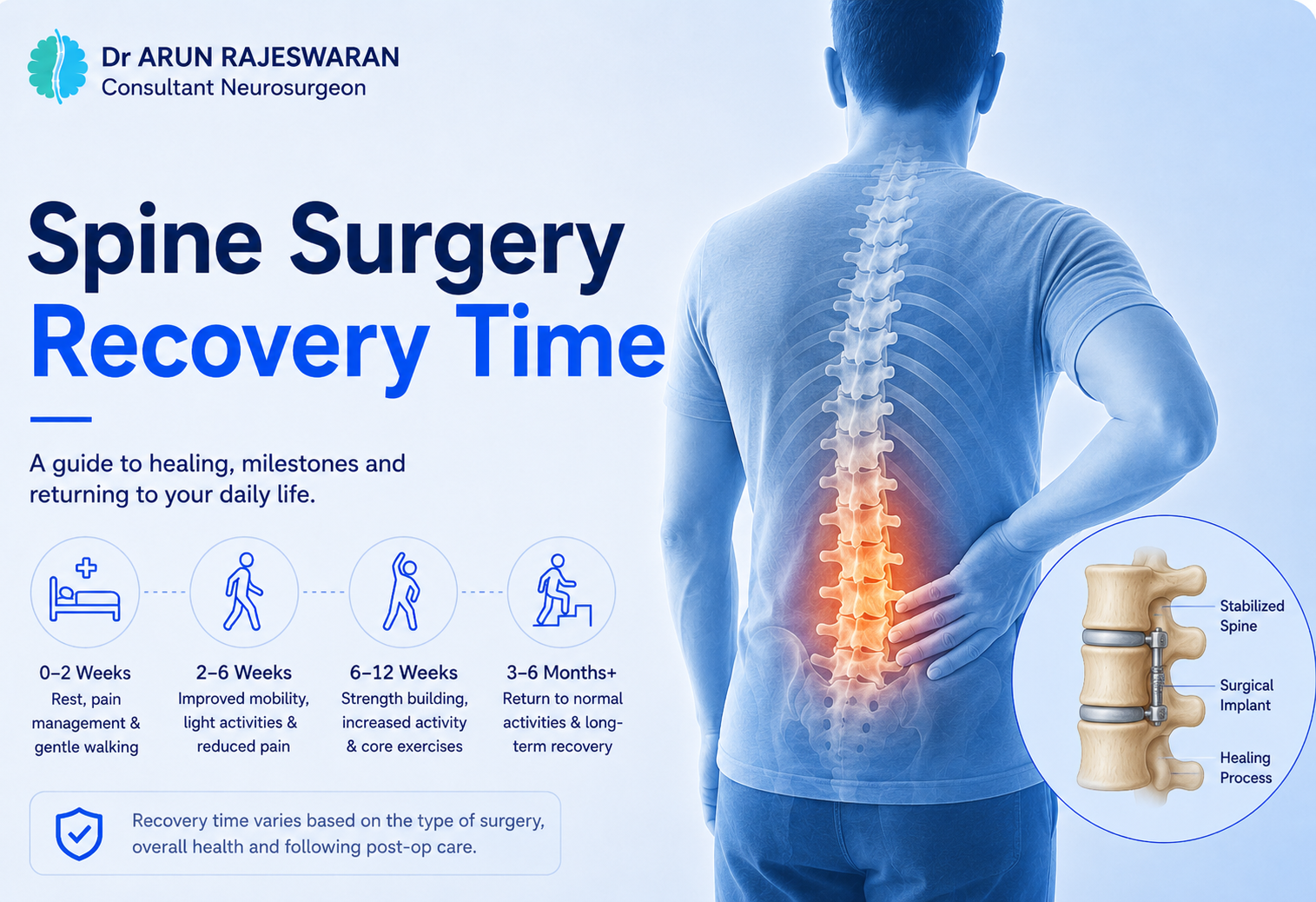
Week-by-Week Recovery Guide
Week 1: The Immediate Post-Operative Period
Pain is at its most noticeable in the first week. This is partly surgical pain from the incision and tissue handling, and partly the residual inflammation around the operated nerve or spinal level.
Walking short distances begins on the day of surgery or the following morning for most spine procedures. Being upright and mobile early is important; it reduces the risk of blood clots and starts the rehabilitation process.
For microdiscectomy and endoscopic procedures, many patients are surprised by how much better their leg pain is immediately after surgery. The nerve decompression takes effect quickly. Some residual tingling or numbness may continue; this reflects nerve healing, which takes longer.
For spinal fusion, week one involves more pain management and controlled mobilisation. A back brace may be prescribed.
Weeks 2–4: Early Home Recovery
Pain gradually decreases. Sleeping becomes more comfortable. Short walks should be performed several times a day building distance gradually.
Sitting tolerance improves but prolonged sitting still aggravates most patients. Taking short breaks from sitting every 30–45 minutes is helpful.
For microdiscectomy patients, light desk work from home often becomes feasible in week two to four, provided no heavy lifting or prolonged sitting is involved.
Endoscopic spine surgery patients often reach this stage of function within seven to ten days.
Weeks 4–8: Building Function
Most microdiscectomy and laminectomy patients are meaningfully active by this stage. Walking distance has increased significantly. Stairs are manageable. Driving has typically resumed.
For spinal fusion patients, the bone fusion process is underway but not complete. This is not a period to rush activity. Lifting and bending restrictions remain in effect.
Physiotherapy typically begins in this window for most patients. Core strengthening, posture correction, and guided movement are introduced progressively.
Months 3–6: Functional Recovery
Microdiscectomy and laminectomy patients should be close to full functional recovery by three to four months, with residual nerve healing continuing.
Spinal fusion bone consolidation has significantly progressed by three months. Most patients return to physical work between three and six months.
Returning to exercise, sport, and more demanding physical activity is guided by physiotherapy and reviewed at clinic appointments with follow-up imaging when appropriate.
6–12 Months: Full Recovery
Nerve healing after decompression can continue for up to twelve months. Some residual numbness or tingling that persists at three to six months may continue to improve.
Spinal fusion is generally considered solid bone at six to twelve months, confirmed on CT imaging.
Driving Restrictions After Spine Surgery
Driving requires the ability to perform an emergency stop a rapid, forceful movement of the foot onto the brake pedal. Any surgery that limits leg strength, pain-free movement, or reaction speed makes driving unsafe in the early recovery period.
- Microdiscectomy / Laminectomy: typically two to four weeks, depending on whether the operated level was lumbar or cervical and whether opioid pain medication is still in use
- Spinal Fusion: typically four to six weeks for lumbar; cervical fusion patients may return sooner if arm function is adequate
- Endoscopic Spine Surgery: often one to two weeks
Always confirm with your surgeon before returning to driving. Some insurance policies require medical clearance after spine surgery.
Exercise After Spine Surgery
Activity | Microdiscectomy | Spinal Fusion |
|---|---|---|
Walking (short) | Day 1 post-op | Day 2–3 post-op |
Walking (extended) | Week 2–3 | Week 3–4 |
Swimming | Week 4–6 | Week 8–12 |
Cycling (stationary) | Week 4–6 | Week 8–12 |
Gym (light) | Week 6–8 | Month 3–4 |
Running | Month 2–3 | Month 4–6 |
Heavy lifting / contact sport | Month 3+ | Month 6+ |
Red Flags: When to Seek Urgent Medical Attention
Most post-operative discomfort is expected and manageable. The following symptoms require prompt medical review:
- Sudden loss of bladder or bowel control this may indicate cauda equina involvement and is a surgical emergency
- Progressive increase in leg or arm weakness after an initial improvement
- Wound redness, increasing warmth, swelling, or discharge potential sign of infection
- Fever above 38.5°C
- Severe headache that is new or worsening
- Increasing back pain that is significantly worse than the day before
- Leg swelling, calf pain, or shortness of breath potential signs of DVT or pulmonary embolism
Nerve Healing After Spine Surgery
Many patients expect that nerve pain and numbness will resolve immediately after a successful decompression. In reality, nerve healing is a slow biological process.
After a nerve has been compressed for a period of time, it takes weeks to months to recover function. Pain usually improves first. Weakness often follows over a period of weeks. Numbness can persist the longest, sometimes partially, sometimes fully resolving over six to twelve months.
If nerve symptoms have been present for a long time before surgery, recovery may be incomplete. Early surgical intervention before significant nerve damage has accumulated generally produces better neurological recovery.
Conclusion
Recovery from spine surgery follows a predictable pattern for most patients, with variations depending on the procedure performed and individual factors. Understanding the realistic timeline avoids both premature return to activity and unnecessary prolonged restriction.
If you have been advised neurosurgery or are experiencing symptoms affecting your brain, spine, or nerves, consult Dr. Arun for a detailed evaluation and personalised treatment plan.
Frequently Asked Questions
Recovery time varies by procedure. Microdiscectomy patients return to light activity within two to four weeks and full function within six to twelve weeks. Laminectomy recovery is similar. Spinal fusion requires six to twelve months for complete bone fusion and full activity. Endoscopic spine surgery offers the fastest recovery, often two to four weeks for desk work.
Desk-based workers can often return to work from home within two to four weeks after microdiscectomy or laminectomy, and within one to three weeks after endoscopic surgery. Spinal fusion patients typically need six to twelve weeks before returning to desk work. Physical or manual workers require significantly longer across all procedures.
Most patients can return to driving two to four weeks after microdiscectomy or laminectomy, and four to six weeks after spinal fusion. Endoscopic spine surgery patients often return sooner around one to two weeks. Driving before medical clearance is unsafe and may invalidate insurance coverage.
Nerve healing after spinal decompression takes weeks to months. Pain usually improves quickly post-operatively. Numbness and tingling may persist for three to twelve months. Weakness improves over weeks to months depending on how long the nerve was compressed before surgery.
In the first six weeks, avoid lifting anything heavier than a kettle, prolonged bending, twisting the spine, high-impact activities, and sports. Specific restrictions vary by procedure and should be discussed with your surgeon. Physiotherapy will guide a safe, progressive return to activity.