
Blog
Sciatica Treatment: A Spine Neurosurgeon’s Guide to Relief, Recovery, and When Surgery Is Needed
- 30 May, 2026
- Dr. Arun Rajeswaran
- No comment
Sciatica Treatment: A Spine Neurosurgeon’s Guide to Relief, Recovery, and When Surgery Is Needed
Most people who develop sciatica want one thing: for the pain to stop.
The burning, shooting, sometimes electric pain that runs from the lower back down through the leg is difficult to describe to someone who has not felt it. Sitting is uncomfortable. Sleeping is hard. Some patients find walking manageable; others cannot get from one room to another without the pain taking over.
The good news is that the majority of sciatica cases do get better. Most do not need surgery. But the treatment approach matters, and getting it right from the beginning can significantly shorten the recovery.
What Sciatica Actually Is
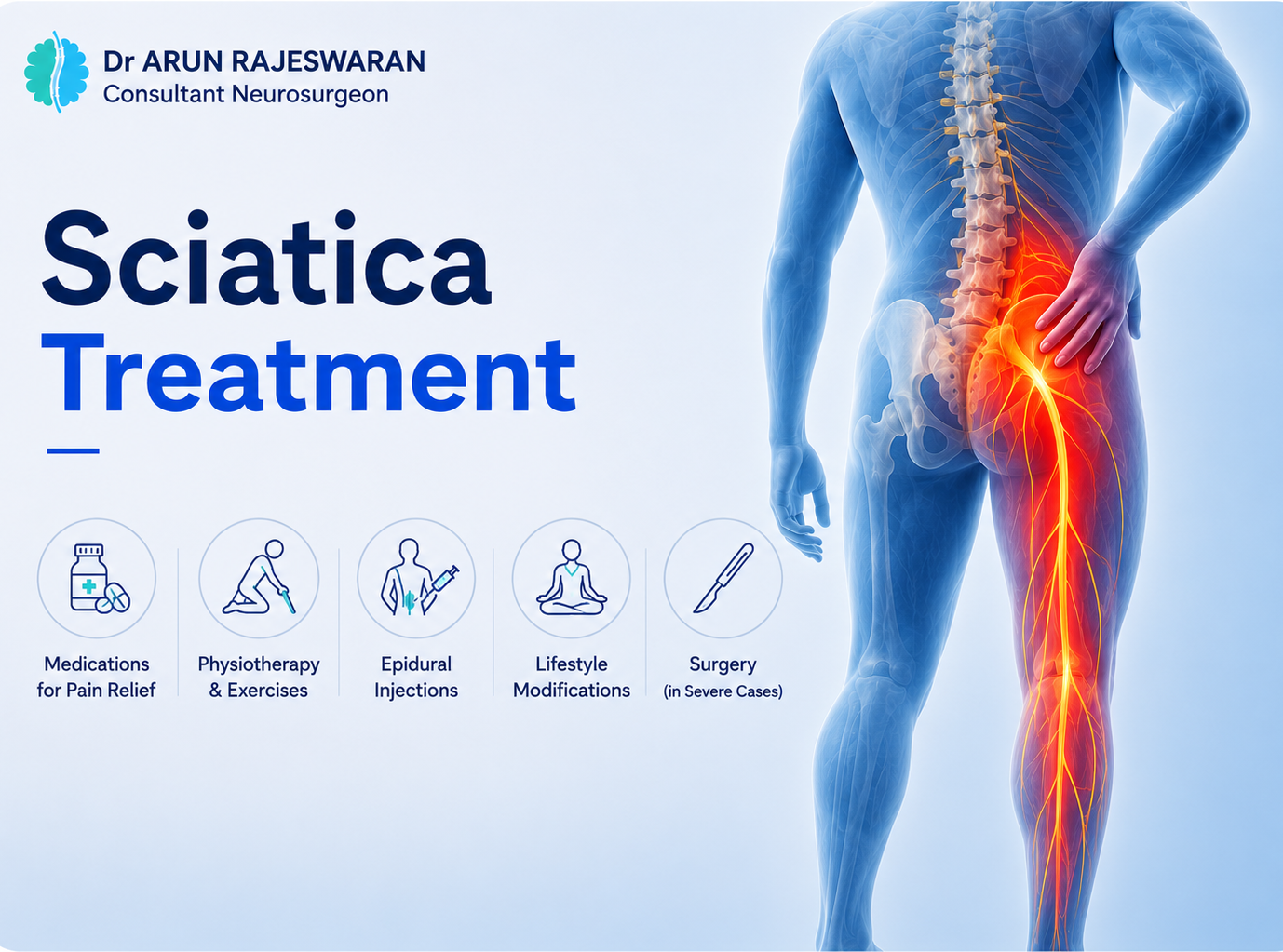
Sciatica is not a diagnosis on its own. It is a symptom. Specifically, it describes pain that runs along the course of the sciatic nerve, which forms from several nerve roots in the lower lumbar and sacral spine and travels down through the buttock, the back of the thigh, the calf, and into the foot.
When something compresses one of the nerve roots that forms part of the sciatic nerve, pain travels along its entire route. The brain cannot always tell that the source of the problem is in the back. It perceives the pain wherever the nerve goes.
The most common cause is a lumbar disc herniation. Herniated disc material presses against a nerve root. A bulge at L4/L5 typically affects the L5 nerve root, producing pain down the outer thigh, outer shin, and top of the foot. At L5/S1, the S1 nerve root is usually involved, and pain runs down the back of the thigh and calf, into the heel.
Spinal stenosis narrowing of the spinal canal is another common cause, particularly in older adults. Bony overgrowths and thickened ligaments compress the nerve roots over a broader area. This tends to cause leg pain with walking that eases when sitting or leaning forward, rather than the constant lancinating pain of a disc herniation.
Conservative Sciatica Treatment: The First Approach
For most patients, conservative treatment is where management begins. And for most patients, it is where it ends too, because symptoms resolve without surgery.
Staying active matters. Rest has a role in the acute phase, particularly in the first few days when pain is severe. But prolonged bed rest is not helpful and can slow recovery. Gentle movement, within the limits of pain, keeps the muscles supporting the spine active and prevents deconditioning.
Medications for pain management are important in the early weeks. Anti-inflammatories like ibuprofen or naproxen reduce the inflammation around the compressed nerve. Paracetamol provides background pain relief. Nerve pain medications gabapentin and pregabalin target the specific burning, electric quality of radicular pain, which standard painkillers do not address well. Muscle relaxants are sometimes used short-term if significant spasm is present.
Physiotherapy is a central part of conservative treatment. A skilled physiotherapist provides specific exercises to centralise and reduce nerve pain, works on posture and movement patterns that are loading the spine poorly, and teaches the patient how to manage their symptoms actively. McKenzie technique exercises, neural mobilisation, and core stabilisation all have roles depending on the clinical picture.
Heat and ice can help with comfort in the short term. Neither addresses the underlying nerve compression, but they can take the edge off acute pain.
Epidural Steroid Injections
When conservative treatment is not producing enough improvement after several weeks, epidural steroid injections are often the next step.
The injection delivers a corticosteroid directly into the epidural space around the affected nerve root. The steroid reduces inflammation acutely, which can significantly reduce pain and allow the patient to engage more effectively with physiotherapy.
The effects are often described as a window to a period of reduced pain within which rehabilitation can progress. For many patients, that window is enough. Pain levels drop, function improves, and the body continues its own healing process.
Results vary. Some patients experience substantial relief lasting months. Some experience partial relief. Some do not respond meaningfully. The injection does not remove the disc herniation or change the structural cause. It manages the inflammatory component.
Injections can be repeated, usually up to three times in a year. They carry a small risk of infection, headache from dural puncture, and temporary worsening of pain immediately after the procedure.
Surgery for Sciatica: When Is It Needed?
Surgery is not the default for sciatica. But there are clear situations where it becomes the most appropriate path.
The most straightforward indication is progressive neurological deficit. If the leg is getting weaker, if foot drop is developing, if the ability to push off the toes is decreasing the nerve is under significant and worsening pressure. Conservative treatment cannot reverse this. Surgery to decompress the nerve gives the best chance of neurological recovery.
Failure to improve after adequate conservative treatment is the most common route to surgery. If a patient has had three to six months of physiotherapy, appropriate medication, and possibly an injection, and symptoms remain severe enough to significantly affect daily life, surgery becomes a reasonable and proportionate option.
Unbearable pain intensity, where quality of life is severely affected despite maximal conservative treatment, is a valid reason to consider surgery sooner rather than later. There is no medal for enduring months of severe pain unnecessarily.
Cauda equina syndrome bilateral leg symptoms, bladder or bowel dysfunction, saddle numbness is a surgical emergency regardless of how long symptoms have been present.
What Sciatica Surgery Involves
The most commonly performed operation for lumbar disc herniation causing sciatica is a microdiscectomy.
Through a small incision in the back, and using a microscope or magnification, the herniated disc fragment that is pressing on the nerve root is removed. The disc itself is not removed entirely. Only the extruded or herniated portion is taken out.
Recovery is generally straightforward. Most patients are mobile the same day or the day after surgery. Hospital stay is typicaly one to two days. Many patients notice significant reduction in leg pain almost immediately after the procedure. The back takes slightly longer than the leg to recover.
For stenosis-related sciatica, the surgical procedure is a laminectomy or laminotomy, creating more space within the spinal canal by removing the bone and thickened ligament that are causing the compression.
Full recovery from microdiscectomy, in terms of returning to normal activity and exercise, typically takes six to twelve weeks. Most patients return to desk work within two to four weeks.
What Helps at Home
Posture management matters throughout treatment. Sitting for long periods tends to increase disc pressure and worsen nerve pain. Breaking up sitting time, using a lumbar support cushion, and keeping the natural lumbar curve when seated helps.
Sleeping position affects symptoms. Many patients find lying on their back with a pillow under the knees, or on their side with a pillow between the knees, most comfortable.
Walking is one of the most therapeutic activities for sciatica. Short, regular walks are better than staying still.
Swimming and cycling in an upright position are low-impact options that maintain cardiovascular fitness without loading the spine in the same way running or impact activities do.
Avoid heavy lifting, especially with a bent and twisted spine, during the acute phase.
Frequently Asked Questions
In the acute phase, a combination of anti-inflammatory medication, short-term rest from aggravating activities, and ice or heat for comfort provides the quickest initial relief. Nerve pain medications like gabapentin or pregabalin specifically target the burning and electric quality of sciatica and can make a significant difference within the first week or two. Once the acute flare settles, gentle movement and physiotherapy are what support recovery. If pain is severe and not controlled with these measures, an epidural steroid injection can provide faster relief than continued conservative management alone.
Yes, in the majority of cases. The underlying disc herniation can reduce in size as the body reabsorbs the herniated material. Inflammation around the nerve settles over weeks to months. Studies consistently show that around 80–90% of disc herniations causing sciatica improve without surgery within three to six months. The timeline is individual, and symptoms can fluctuate during the recovery period. Conservative treatment supports and accelerates this natural process rather than simply waiting.
Surgery is most clearly needed when progressive neurological weakness is developing particularly foot drop or worsening leg weakness. It is also appropriate when adequate conservative treatment including physiotherapy and possibly an injection has not produced sufficient improvement after three to six months, and symptoms are significantly affecting quality of life. In cases of cauda equina syndrome, surgery is an emergency regardless of duration. Surgery is not the default, but when the above criteria are met, it reliably reduces leg pain and helps recovery.
Epidural steroid injections are a well-established part of sciatica management when conservative treatment alone is insufficient. They reduce inflammation around the compressed nerve root, which can significantly lower pain levels for weeks to months. They work best when used as part of a broader treatment plan that includes physiotherapy. They do not address the structural cause of the compression and do not prevent future episodes. Response varies between individuals. They are a useful middle step between conservative management and surgery, and for many patients, they provide enough relief to avoid an operation.
Most episodes of acute sciatica from a disc herniation improve significantly within six to twelve weeks. Some take longer, particularly when the herniation is large or the nerve is significantly compressed. Full resolution of all symptoms can take three to six months. A small proportion of patients roughly 10–20% do not improve adequately with conservative management and eventually require surgery. Recovery after surgery, particularly from microdiscectomy, is generally faster than the same patient waiting out a prolonged conservative course.