
Blog
Causes of Back Pain: What Is Actually Going On, and When It Needs a Specialist
- 30 May, 2026
- Dr. Arun Rajeswaran
- No comment
Causes of Back Pain: What Is Actually Going On, and When It Needs a Specialist
Almost everyone has had back pain at some point. For most people, it comes on, lasts a few days or weeks, and goes away. Life goes on.
But for many patients, back pain keeps coming back. Or it does not go away at all. Or new symptoms appear alongside it pain shooting into the leg, numbness, weakness and the whole picture becomes more concerning.
Understanding what is actually causing the pain changes how it is managed. Not all back pain is the same, and not all of it needs the same treatment. Some need rest and physiotherapy. Some need imaging. And some need urgent specialist attention.
The Lumbar Spine: Why the Lower Back Bears So Much
The lower back the lumbar spine carries a significant share of the body’s weight and handles the most movement. Bending, lifting, twisting, and sitting all load the lumbar spine. It is not surprising that it is the most common site for back pain.
Five lumbar vertebrae stack on top of each other, separated by discs. Ligaments hold the structure together. Muscles run alongside and support it. Facet joints at the back of each vertebral level allow controlled movement.
When any of these structures is strained, inflamed, compressed, or degenerating, back pain follows.
The Most Common Causes
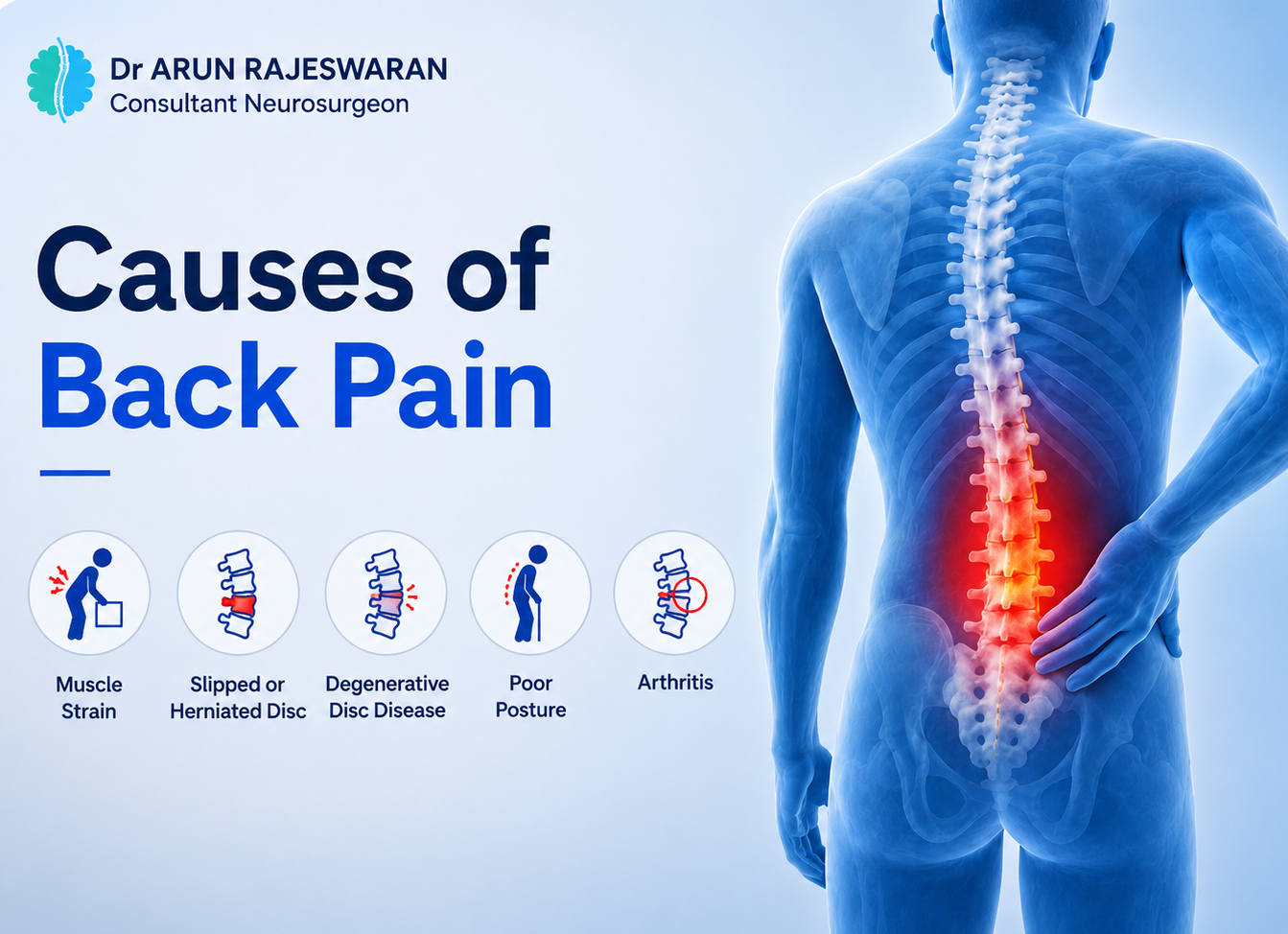
Muscle and ligament strain is the most frequent cause of acute back pain. Lifting incorrectly, a sudden awkward movement, or sustained poor posture can overload the soft tissues. The result is local pain, stiffness, and muscle spasm. It is usually short-lived, responds well to simple measures, and does not require imaging.
Disc herniation happens when the inner gel of a spinal disc pushes through its outer casing and compresses a nearby nerve. This is what most people mean when they talk about a “slipped disc.” Back pain may be part of the picture, but nerve compression produces leg pain often shooting, burning, or electric that follows a specific route. This is a different presentation to simple muscle strain.
Degenerative disc disease is a natural part of ageing. Discs gradually lose their hydration and height over time. The spine becomes stiffer, movement decreases, and localised back pain can develop. Not everyone with disc degeneration on an MRI has pain. The imaging changes do not always correlate directly with symptoms. But in some patients, degeneration drives persistent, aching back pain, particularly after long periods of standing or activity.
Facet joint problems are common and often underappreciated. The small joints at the back of each vertebral level can develop arthritis, become inflamed, or be strained acutely. Facet pain tends to be central or slightly to one side of the spine, often worse on extension leaning back or first thing in the morning.
Spinal stenosis is a narrowing of the spinal canal, usually from a combination of disc bulging, facet joint enlargement, and thickened ligaments. It compresses the nerves inside the canal. Patients with lumbar stenosis often describe back pain combined with leg pain and fatigue that comes on with walking and is relieved by sitting or bending forward. Uphill walking tends to be easier than walking on the flat.
Vertebral fractures from osteoporosis can cause sudden, severe back pain, particularly in older women. The bone collapses under normal loading because it has lost density. This is called a compression fracture. It is not always preceded by significant trauma. Sometimes it happens with something as minor as a sneeze.
Inflammatory conditions like ankylosing spondylitis cause back pain with a specific pattern: young adults, worse in the morning, improving with activity, associated with stiffness lasting more than an hour on waking. This is different from mechanical back pain, which tends to worsen with activity and improve with rest.
Upper Back Pain: Different Anatomy, Different Causes
The thoracic spine the mid and upper back is more rigid than the lumbar spine because it connects to the rib cage. Disc herniations are less common here. Most thoracic back pain is muscular, posture-related, or stems from the costovertebral joints where the ribs attach.
Long hours at a desk with poor posture head forward, shoulders rounded load the upper back muscles heavily. This is one of the most common drivers of upper and mid-back discomfort in working adults.
Thoracic disc herniations do occur, and when they do, they can compress the spinal cord rather than just a nerve root, because the spinal cord runs through this region. This is less common but more serious when it happens.
Vertebral fractures, malignancy, and aortic pathology can also cause thoracic back pain. These are rarer causes, but back pain that is constant, not related to posture or movement, does not improve with rest, and is associated with systemic symptoms like weight loss or night sweats needs investigation for these causes.
Why Back Pain Keeps Coming Back
Recurrent back pain is one of the most frustrating experiences patients describe. Just when things seem better, it comes back.
Several factors drive recurrence. Deconditioned core muscles leave the spine with less support. Poor movement habits the way someone bends, lifts, or sits repeatedly reload the same structures. Underlying degeneration does not reverse itself, so the structural vulnerability remains even after acute episodes settle.
Stress and sleep quality affect pain perception significantly. Persistent back pain has a psychological dimension that is not separate from the physical one. Anxiety, low mood, and poor sleep amplify pain signals in ways that are well-documented in the literature.
Addressing recurrent back pain properly means addressing all of these components, not just treating each acute episode in isolation.
Red Flag Symptoms: When Back Pain Is Serious
Most back pain is mechanical and not dangerous. But certain symptoms indicate a problem that needs prompt investigation.
Bladder or bowel dysfunction alongside back and leg symptoms is the most urgent red flag. Difficulty passing urine, loss of control, or numbness in the perineal region suggests cauda equina compression. This is a surgical emergency.
Progressive leg weakness alongside back pain particularly bilateral needs urgent assessment.
Back pain in someone with a history of cancer, even if the cancer was treated years ago, needs imaging to rule out spinal metastasis.
Constant, severe back pain that is not related to posture or movement and does not improve with rest raises concern for an inflammatory, infective, or malignant cause.
Fever with back pain may indicate a spinal infection, which can be serious if untreated.
Significant trauma a fall from height, a road traffic accident, sports impact with new back pain needs imaging to assess for fracture.
Diagnosing the Cause
A detailed history of the pain, its character, location, what worsens and relieves it, whether it radiates, and how it has changed over time tells a great deal before any scan is done.
A physical and neurological examination assesses posture, range of movement, straight leg raise testing, reflexes, and power in the legs.
Imaging follows when indicated. X-rays show bone structure and alignment. MRI is the best investigation for discs, nerves, and spinal cord. CT scanning is better for detailed bone anatomy. Not every episode of back pain needs imaging. The clinical picture guides the decision.
When to See a Specialist
Most uncomplicated back pain is managed appropriately by a GP and physiotherapist. That is the right pathway for most people.
A spine specialist consultation is appropriate when symptoms are not improving after six to twelve weeks of conservative management. When neurological signs have developed leg weakness, persistent numbness, or reflex changes. When imaging has shown a structural problem that needs interpretation. When pain is significantly affecting function and quality of life. And immediately when any of the red flag symptoms described above are present.
Early specialist assessment does not mean surgery. It means getting the right diagnosis and a properly tailored plan. In my practice, most patients with back pain leave with a conservative plan, not a surgical one. But knowing what you are dealing with makes everything more manageable.
Frequently Asked Questions
Muscle and ligament strain is the single most common cause, particularly in the lumbar spine. It is usually triggered by lifting, twisting, prolonged poor posture, or simple day-to-day overloading of the soft tissues. It tends to settle within a few weeks with rest, gentle activity, and simple analgesia. Disc-related problems and facet joint degeneration are the next most common causes, particularly in people with recurrent or persistent back pain.
Most back pain is mechanical and not dangerous. Red flag symptoms that warrant urgent assessment include bladder or bowel dysfunction alongside back pain, progressive leg weakness, back pain in someone with a history of cancer, constant pain that is not related to posture and does not improve with rest, fever, and significant trauma. Any of these changes the picture from routine back pain to something that needs prompt investigation.
Yes, and it does in a significant number of patients. Sustained poor posture, particularly prolonged sitting with the head forward and back rounded, loads the lumbar and thoracic spine unevenly over hours each day. Over time, this contributes to muscle imbalance, disc loading, and facet joint stress. It does not cause dramatic structural damage quickly, but as a chronic loading pattern it plays a real role in persistent back pain, particularly in desk-based workers.
Recurrent back pain usually reflects a combination of ongoing structural vulnerability, deconditioned supporting muscles, and movement habits that keep reloading the same structures. The underlying cause whether disc degeneration, facet joint arthritis, or a previous herniation does not disappear between episodes. Without addressing the contributing factors properly through exercise, posture modification, and sometimes structural treatment, the cycle tends to continue.