
Blog
What Causes Trigeminal Neuralgia? A Neurosurgeon Explains
- 29 May, 2026
- Dr. Arun Rajeswaran
- No comment
What Causes Trigeminal Neuralgia? A Neurosurgeon Explains
The pain arrives without warning. One side of the face. A sharp electric jolt. Gone in seconds. Then back again from something as ordinary as a sip of water.
Most people who experience it have never felt anything like it. And the first thing they want to know is simple: why is this happening?
That question deserves a proper answer. Because the cause determines everything — what treatment makes sense, whether surgery might help, and what recovery could look like. So let me walk through what we actually know about why this condition develops.
The Trigeminal Nerve: What It Is and What It Does
You have one trigeminal nerve on each side of your face. It is the fifth cranial nerve. Its job is to carry sensation from your face up to your brain. Touch, temperature, pressure all of it travels through this nerve.
It has three branches. Each covers a different region.
The upper branch runs across the forehead and near the eye. The middle one covers the cheek and upper lip. The lower branch supplies the jaw, lower teeth, and chin. Most people with this condition feel pain in the middle or lower branch. So the cheek, jaw, or lower face tends to be where it hits.
Under normal circumstances, a light touch on your face sends a calm signal up through these branches. Nothing dramatic happens. But in trigeminal neuralgia, the nerve becomes overreactive. It reads ordinary touch as severe pain. And that is when the shock sensation appears.
So what makes the nerve behave that way? That depends on the cause.
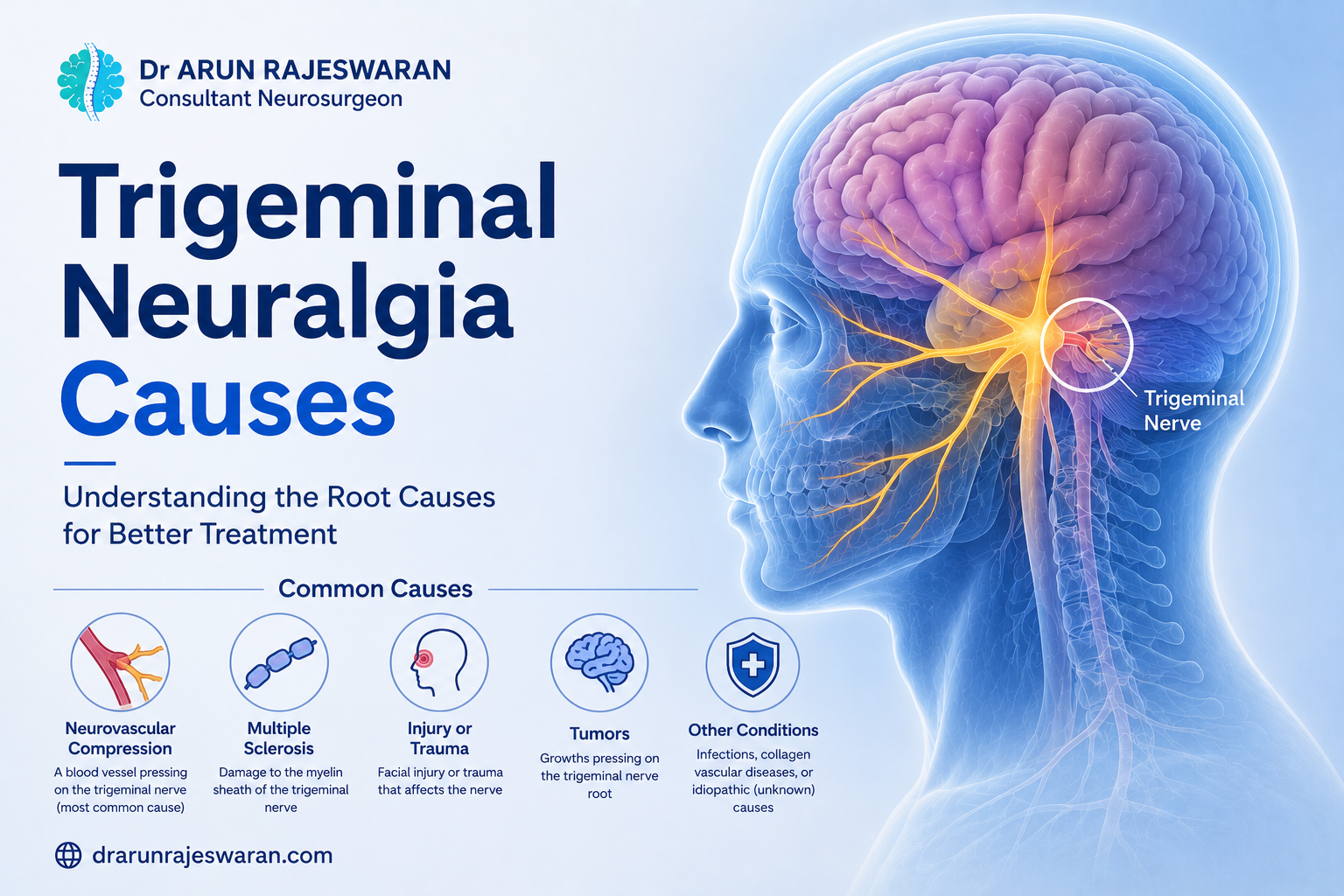
The Most Frequent Cause: A Blood Vessel Pressing on the Nerve
In most people, a blood vessel is responsible. Specifically, one that rests against the nerve at a point called the root entry zone. That is where the nerve meets the brainstem.
And that is where things go wrong.
The vessel does not press hard. It just sits there. But every heartbeat sends a small pulse through it. Over time, that repeated contact slowly wears down the nerve’s outer coating. Once that layer is damaged, the nerve starts misfiring. It treats a gentle touch like a serious threat. The result is the stabbing, electric-shock pain that patients describe.
The artery most often responsible is the superior cerebellar artery. It runs naturally close to the nerve. In many people, the geometry is fine and nothing happens. But in some, it curves just a little too close to the nerve root. That small difference is enough to start the problem.
Other arteries can be involved too. Occasionally it is a vein rather than an artery.
When a vessel is the cause, doctors call it classical trigeminal neuralgia. It accounts for the majority of cases.
Worth noting: not everyone with some vessel-nerve contact develops pain. How much contact there is, where exactly it sits, and how sensitive the nerve is all play a part. A properly reported MRI helps sort this out. It shows the nerve and the vessel and how they relate to each other.
Why It Often Appears After Fifty
Trigeminal neuralgia is most common in people over fifty. It also affects women more often than men, though no one fully understands why.
Blood vessels change with age. They develop mild curves and loops. In the tight space near the brainstem, a vessel that once sat quietly next to the nerve can gradually drift a little closer. That slow drift can eventually produce enough contact to irritate the nerve. Symptoms then follow.
When it occurs in a younger adult, a secondary cause is usually worth investigating.
When Multiple Sclerosis Is the Reason
MS is a recognised cause, particularly in younger patients.
In MS, the immune system attacks the protective myelin coating around nerve fibres. When that damage reaches the trigeminal nerve’s pathway inside the brainstem, it disrupts how the nerve conducts signals. Pain follows.
Research has also shown that some MS patients have both demyelination and vessel compression present at the same time. Each one adds to the nerve’s irritability. Some neurologists call it a double-crush. Two separate problems, each making the other worse.
Knowing this changes what treatment options are worth discussing. Some patients with MS may still benefit from surgical intervention, even though MS was once thought to rule that out entirely.
One other thing worth noting: trigeminal neuralgia tied to MS is more likely to affect both sides of the face at some point. Not necessarily together, but over time. In the classical form, it is almost always one-sided.
If you have MS and develop facial pain fitting this description, mention it specifically to your specialist. It needs a different kind of workup.
Tumours and Structural Problems
A smaller number of cases involve a tumour or growth pressing on the nerve. These are uncommon. But they need to be found.
Tumours near the base of the skull, such as meningiomas or epidermoid cysts, can press on the nerve and produce pain that looks identical to the classical form. Abnormal clusters of blood vessels, called arteriovenous malformations, can cause the same.
When a structural problem is found on imaging, treatment targets it directly. That approach is quite different from managing simple vessel compression.
Ruling out these causes is why a scan is always needed for a new diagnosis of this type. Some causes require a completely different treatment plan.
When No Cause Is Found
Sometimes all the tests come back clear. No obvious vessel contact. No lesion. No underlying condition. The nerve looks normal.
Doctors call this idiopathic trigeminal neuralgia.
The pain is no less real. The nerve is still misfiring. The changes are simply too subtle for current imaging to pick up. Research into this group continues. Some scientists think a microscopic demyelinating process may be involved in at least some of these cases, though standard MRI cannot yet confirm it.
Triggers Are Not the Cause
Many patients confuse these two things. It helps to keep them separate.
The underlying cause is what a neurosurgeon needs to find and treat. It lives inside the nerve or the anatomy around it.
Triggers are different. They are the everyday things that set off an episode. Eating, talking, brushing teeth, cold water, wind on the face. They do not create the condition. They provoke an attack in a nerve that is already sensitised by something else.
Avoiding triggers helps day-to-day. It does not fix the root problem.
Other, Less Common Factors
A few other situations can lead to trigeminal nerve pain, though they sit outside the classical form.
Trauma to the face or nerve, from an accident or a procedure, can sometimes produce persistent facial pain. It usually feels different: more constant, more of a burning sensation, rather than the sharp jolts of the classical form. Doctors usually classify this separately.
The herpes zoster virus, the one behind shingles, can affect the trigeminal nerve too. Pain from this tends to be ongoing rather than episodic. It usually follows a visible skin rash in the same area, which helps identify it.
Dental treatment sometimes gets blamed. Many patients first notice the pain around a dental visit. In most cases, though, the condition was already developing. The appointment simply brought it to attention. Getting the right diagnosis early prevents unnecessary further dental work.
How I Approach the Evaluation
I want to understand why the pain is happening before we talk about how to treat it. That order matters.
A careful clinical history comes first. Where does the pain sit exactly? What brings it on? How long does each episode last? Is there a background ache between the sharp attacks? One side or both? These details already narrow down the likely cause before any imaging is done.
A high-resolution MRI follows. It needs to be specifically set up for the trigeminal nerve, not a standard brain scan. A general scan often misses the level of detail needed. A properly protocolled MRI shows the nerve, the vessels around it, and the root entry zone clearly. It picks up vessel contact, plaques, tumours, or other structural changes.
If anything in the history points toward MS or another systemic condition, further neurological assessment is arranged alongside this.
With the cause clear, the treatment decision follows naturally. Whether that means medication, a nerve procedure, or microvascular decompression surgery depends heavily on what is actually driving the pain.
A Word Before We Close
Getting this diagnosis is unsettling. The pain itself is severe. The unpredictability wears people down. Not knowing the reason behind it makes everything harder.
Most causes of trigeminal neuralgia can be treated well. Vessel compression can be addressed surgically with a high rate of long-term success. Even when MS or a structural lesion is behind it, real options exist.
A solid diagnosis is where the path forward begins. Good imaging, a careful assessment, and a specialist who takes time with your specific situation — that combination makes all the difference.
Frequently Asked Questions
A blood vessel pressing on the nerve at its root entry zone. The superior cerebellar artery is responsible in most cases. Its pulse gradually damages the nerve’s outer coating over time, causing it to misfire and produce intense facial pain. Doctors call this classical trigeminal neuralgia.
Yes. When MS creates plaques along the trigeminal pathway in the brainstem, it disrupts how the nerve conducts signals. Some patients also have vessel compression alongside the plaque. Together, the two problems can amplify each other. MS-related cases tend to affect younger patients and may involve both sides of the face over time, which is unusual in the classical form.
Common triggers include light touch, eating, drinking, talking, brushing teeth, and cold air. They do not cause the condition. They provoke an episode in a nerve that is already sensitised by something deeper. Avoiding them helps with daily life, but it does not address the actual cause.
Yes, in a small number of cases. Tumours near the skull base, including meningiomas and epidermoid cysts, can press on the nerve and produce identical pain. Ruling out a structural cause is one reason imaging is essential for every new diagnosis.
If the pain is sudden, severe, and shock-like, and if everyday activities like eating or talking trigger it, a specialist opinion is worthwhile. Especially if medication is not helping enough, or if the pain has begun affecting daily life in a noticeable way. Seeing someone early leaves more options open.